cat. no. TESTOSTERONE-PROPIONATE
Testosterone propionate: dosage, half-life and storage
Androgen (esterified testosterone, injectable oil depot; short-acting ester)
also: Test P / Prop / Testosterone propionate injection
By An NayalLast reviewed 2 sources
At a glance
On this card (9)
What it is
Testosterone propionate is testosterone with a short fatty-acid ester (propionate) attached, dissolved in oil and injected into muscle. The oil forms a small depot that releases the hormone as the body clips off the ester, but propionate is the shortest of the common testosterone esters, with a half-life of about 1 day. That short half-life is the whole story: levels rise and fall quickly, so it is injected frequently - historically every 2 to 3 days - and each shot gives a sharper peak and a faster drop than longer esters like cypionate or enanthate. It was the main medical form of testosterone before about 1960 and has largely been superseded by longer-acting esters. No current US patient label for the injectable was found; the figures here come from pharmacology literature, not a modern drug label.
The molecule
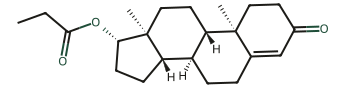
2D structure · PubChem record, redrawn
Dose ranges
Study-backed ranges carry a source you can open. Community ranges are widely reported but not clinically established - treat them as what people do, not as advice.
Historical and community-reported androgen use - short ester, frequent injection to offset the fast clearance
communitycommonly 25-50 per injection mg
intramuscular, roughly every 2 to 3 days (about 2 to 3 times weekly)
Gray-market / performance context - the short ester is run at high injection frequency to blunt the sharp peaks and troughs
community50-100 per injection mg
intramuscular, every day to every other day
Storage
Reconstituted
No current US patient label was resolvable to confirm storage. As a sterile oil solution (not a lyophilized powder for reconstitution), general handling is to store at controlled room temperature, 20 to 25 C (68 to 77 F), protect from light, and not refrigerate or freeze. If the oil has thickened when cold, warming the vial and gently rolling (not shaking) helps. Confirm against the specific product's own labeling.
Ships as a known-concentration oil in a 10 mL multi-dose vial (100 mg/mL), drawn with a syringe - nothing to reconstitute.
Work out your draw volume in the calculatorTools for Testosterone propionate
Stacks and pairings
Interactions & cautions
These are established effects of testosterone as an androgen class rather than claims drawn from a propionate-specific US patient label (none was resolvable - see unverifiable notes). Injected testosterone is aromatized to estradiol, so estradiol tends to rise alongside testosterone. It also suppresses the hypothalamic-pituitary-testicular axis: luteinizing hormone falls and endogenous testosterone production and spermatogenesis are suppressed, which is the basis for the fertility concern on testosterone therapy and for the hCG that is sometimes used alongside it. Testosterone raises red-cell mass, so hematocrit is commonly monitored for polycythemia during long-term use. Androgens can increase sensitivity to oral anticoagulants such as warfarin, so anticoagulant dosing may need review. Because propionate is a short ester with a roughly 1-day half-life, single injections produce sharper peaks and faster troughs than the longer esters, so any aromatization-driven estradiol swing and the peak-to-trough variation are more pronounced per injection - which is why it is injected frequently.
Questions people ask
What is the half-life of testosterone propionate?
About 1 day. A peer-reviewed comparison of short testosterone esters lists a half-life of roughly 1 day for propionate, the shortest of the common injectable esters (acetate is under a day; phenylpropionate about 2.5 days). Other pharmacology references cite figures across roughly 0.8 to 2 days depending on the method. Either way it is short, which is why it is injected often.
Why is it injected so frequently compared to cypionate or enanthate?
Because the ester is short. With a half-life near 1 day, levels peak and fall within a few days, so historical and community practice injects it every 2 to 3 days (or even daily) rather than the every-1-to-2-week schedules used for the longer esters. This is a reported pattern, not personal medical advice - testosterone is a Schedule III controlled substance and dosing is a prescriber's decision.
Is there an FDA-approved label for injectable testosterone propionate?
We could not find a current US human patient label for injectable testosterone propionate in DailyMed. The only testosterone propionate product that resolves in DailyMed is a veterinary cattle ear implant (Synovex H, which combines it with estradiol benzoate), not a human injectable. The dose and frequency figures on this page therefore come from pharmacology literature and community-reported practice, not a modern US drug label.
What concentration is it usually sold at?
Historically the injectable oil was commonly around 100 mg/mL, and 100 mg/mL is the strength most often quoted for compounded and gray-market propionate. We could not confirm a specific concentration from a current US label because none was resolvable, so treat 100 mg/mL as the typical figure and check the actual product's labeling before using the draw-volume calculator.
Does it affect fertility and estradiol the same way as other testosterone esters?
Yes - these are testosterone class effects, independent of which ester is attached. Injected testosterone aromatizes to estradiol and suppresses luteinizing hormone, endogenous testosterone, and sperm production. The short ester just delivers those effects in sharper peaks and faster troughs per injection. Discuss any fertility plan with a clinician; hCG is sometimes used alongside for that reason.
Sources
- [1]Turza A, Popescu V, Mare L, Borodi G. Structural Aspects and Intermolecular Energy for Some Short Testosterone Esters (Materials [Basel], 2022) PMID 36295310studyStates the esterified forms of testosterone have a half-life ranging from around less than 1 day for testosterone acetate, 1 day for propionate, 2.5 days for phenylpropionate, and up to 3.1 days for isocaproate - the source for the ~1-day propionate half-life and for propionate being the shortest of the common injectable esters, hence the need for frequent intramuscular injection.
- [2]SYNOVEX H (testosterone propionate and estradiol benzoate implant) - DailyMed (Zoetis Inc.)label-veterinaryThe only testosterone propionate product that resolves in a DailyMed drug-name search is this veterinary subcutaneous cattle ear implant (200 mg testosterone propionate plus 20 mg estradiol benzoate per implant, for weight gain in beef heifers, explicitly not for use in humans) - documenting that no current US human patient label for injectable testosterone propionate was found.
What we could not verify
No current US human patient label (DailyMed) for injectable testosterone propionate was found. A DailyMed drug-name search for 'testosterone propionate' returned only a single product, the veterinary implant Synovex H (setid 5cdef530-023e-4d34-8e97-77f143b0068f), which is a cattle ear implant not for human use; a filtered human-injection search returned none. fda.gov and accessdata.fda.gov were not used (blocked). The ~1-day half-life is taken from a peer-reviewed open-access paper (Materials 2022, PMC9611952, PMID 36295310), which states 1 day for propionate; widely cited pharmacology references (e.g. the Nieschlag/Behre andrology textbook) give figures across roughly 0.8 to 2 days depending on method, so the numeric half_life_days is set to 1 with that spread noted here. The concentration_mg_per_ml of 100 could NOT be confirmed from an approved primary source (DailyMed, PMC/PubMed, Europe PMC, doi.usp.org); the doi.usp.org monograph DOI resolved only to an 'unpublished version' placeholder, and no fetched paper stated a formulation strength. 100 mg/mL reflects the historical Testosterone Propionate Injection strength and the concentration most commonly quoted for compounded and gray-market product; verify against the specific product before relying on any draw-volume math. All dose_ranges are community-reported or historical practice (source_type community), not an FDA-labeled schedule and not clinical guidance - no human dose-response or clinical-dosing study for testosterone propionate was resolvable in the approved sources. The interactions_notes describe testosterone androgen class effects (aromatization to estradiol, HPTA/LH and spermatogenesis suppression, raised hematocrit, warfarin sensitivity), not claims read off a propionate-specific US label, since none exists to cite. All figures are logged reported facts, not recommendations - testosterone propionate is a US Schedule III controlled substance.
Keep reading
Pepteca is for education and information only. It does not provide medical advice, diagnosis, or treatment, and its calculators perform unit math only. Always verify with a licensed provider before starting, changing, or stopping any protocol. Many peptides are not approved for human use and may be regulated differently where you live.