cat. no. KPV
KPV: dosage, half-life and storage
Tripeptide (Lys-Pro-Val) - the C-terminal fragment of alpha-melanocyte-stimulating hormone (alpha-MSH), positions 11-13
also: Lysine-Proline-Valine / Lys-Pro-Val / alpha-MSH (11-13) / KPV Tripeptide
By An NayalLast reviewed 7 sources
At a glance
On this card (8)
What it is
KPV is a tiny natural fragment - just three amino acids, lysine-proline-valine - clipped from the tail end of alpha-melanocyte-stimulating hormone (alpha-MSH), a hormone the body makes for pigmentation and immune signaling. KPV keeps alpha-MSH's anti-inflammatory punch without needing the receptor that causes tanning: in mouse studies it calmed inflammation even in animals whose MC1 pigmentation receptor did not work, so its anti-inflammatory action runs through a different route - mainly switching off NF-kB, a master switch that turns on inflammatory genes throughout the body. What makes KPV unusual among peptides is that it can be absorbed straight through the gut wall using PepT1, a transporter built to carry small food-derived peptides into cells; most peptides this size get digested before they can do anything. That transporter is also why KPV research focuses so heavily on the gut: in mouse models of colitis (both a chemical-irritant model and an immune-cell-transfer model that mimics Crohn's-like inflammation), oral KPV in the drinking water measurably reduced inflammatory markers, sped weight recovery, and even blocked colon tumor formation in a long-term colitis-to-cancer mouse model - an effect that disappeared once the PepT1 transporter was knocked out, confirming the transporter is doing the work. All of that evidence is mouse and cell-culture data; there is no published human trial. The milligram/microgram self-injection or oral protocols circulating in peptide communities, including pairing KPV with GHK-Cu, BPC-157 and TB-500 in the 'KLOW' stack, are vendor and community convention extrapolated from that preclinical work, not doses established in people.
The molecule
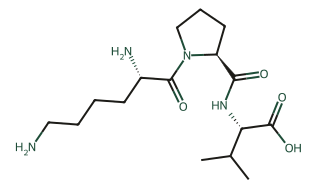
2D structure · PubChem record, redrawn
Dose ranges
Study-backed ranges carry a source you can open. Community ranges are widely reported but not clinically established - treat them as what people do, not as advice.
Intestinal epithelial and immune cell culture (mechanistic, in vitro) - NF-kB and MAP kinase signaling assays
study10 nM
single in vitro incubation
Oral dosing via drinking water, DSS- and TNBS-induced colitis mouse models
study100 µmol/L in drinking water
continuous ad libitum oral exposure during colitis induction
Oral dosing via drinking water, colitis-associated colorectal cancer prevention model (AOM/DSS mice)
study100 µmol/L in drinking water
continuous ad libitum oral exposure during both DSS cycles
Community-reported subcutaneous self-dosing, general anti-inflammatory/gut/skin use, KPV alone
community200-500 mcg
once daily subcutaneous, titrated up over weeks 1-3 then held for weeks 4-8
Community-reported oral/troche dosing, gut-focused use
community500-1500 mcg
once daily, oral
Community KLOW stack (GHK-Cu + BPC-157 + TB-500 + KPV, fixed 50/10/10/10 mg 80 mg vial) - KPV's portion per injection
community250-500 mcg (KPV portion of the KLOW blend)
loading: 500 mcg, 5x/week, weeks 1-4; maintenance: 250 mcg, 3x/week, weeks 5-12; commonly cycled 8-12 weeks on / 4-8 weeks off
Reconstitution & storage
Vendor/community convention, not a clinical or manufacturer standard - no FDA-approved KPV drug product exists. Two different pairings show up across community guides: a 5 mg vial with 5 mL bacteriostatic water (about 1 mg/mL), or a 10 mg vial with 3 mL bacteriostatic water (about 3.33 mg/mL). Reconstituted product is typically measured on a U-100 insulin syringe (1 unit = 0.01 mL), so at 3.33 mg/mL each unit delivers roughly 33 mcg.
Lyophilized
Community/vendor guidance (no clinical monograph exists): store sealed lyophilized powder frozen at -20C or below for long-term stability. Protect from light.
Reconstituted
Community/vendor guidance: refrigerate at 2-8C after mixing; commonly cited usable window is about 4 weeks. Avoid repeated freeze-thaw cycling.
Ships as a white lyophilized powder cake in a 3 mL glass vial (5, 10 mg sizes are typical), reconstituted with bacteriostatic water before use.
Run the numbers in the calculatorStacks and pairings
Interactions & cautions
No human drug-interaction trials exist for KPV, so nothing below is clinically confirmed - it is either reasoned pharmacology or secondary regulatory reporting. A community/compounding-pharmacy review of FDA materials lists open, unresolved safety questions rather than known risks: unknown effects in pregnancy and pediatric use, unknown behavior in people with cancer, autoimmune conditions, renal disease or hepatic impairment, unknown interactions with immunomodulatory medications, and general immunogenicity/impurity risk from unregulated injectable material. The same source reports that in July 2026 FDA's Pharmacy Compounding Advisory Committee (PCAC) gave a favorable recommendation toward adding KPV to the 503A Bulks List, but is explicit that this is advisory only, not FDA approval, and that further FDA rulemaking plus state-level requirements still apply; a direct fetch of FDA's own meeting page 404'd for us, so treat this as secondary reporting rather than a confirmed, current regulatory status. Because the Kannengiesser 2008 mouse study found KPV's anti-inflammatory effect held even in MC1R-deficient animals, KPV is not expected to carry the pigmentation/tanning effects associated with MC1R-agonist melanocortin peptides (e.g., Melanotan II) - but this is a mechanism-based inference from one study, not a dedicated human comparison. As with any unregulated peptide product, the biggest practical risk in community use is likely the product itself - contamination, mislabeling, or wrong concentration - none of which has been studied for KPV specifically.
Questions people ask
Is KPV the same thing as alpha-MSH, and will it tan my skin?
No. KPV is only the last three amino acids (Lys-Pro-Val) of the 13-amino-acid alpha-MSH hormone. In the 2008 Kannengiesser mouse study, KPV's anti-inflammatory effect held up even in mice lacking a working MC1 receptor - the receptor responsible for alpha-MSH's pigmentation and tanning effects - so KPV is not expected to drive the tanning associated with full MC1R agonists like Melanotan II. That said, no dedicated human comparison of the two exists.
Has KPV been tested in human clinical trials?
Not that we could verify. Every controlled study we opened - Dalmasso 2008 (Gastroenterology), Kannengiesser 2008 (Inflammatory Bowel Diseases), and Viennois 2016 (Cellular and Molecular Gastroenterology and Hepatology) - was done in mice or cell culture. Secondary reporting on a 2026 FDA review states FDA found no human exposure data on KPV drug products. Treat any human dosing protocol as community self-experimentation, not clinical evidence.
Why do people take KPV orally instead of just injecting it, unlike most peptides?
Because of PepT1, a transporter that moves small di- and tripeptides across intestinal cell membranes. The 2008 Dalmasso study showed KPV is a substrate for PepT1 and gets taken up by intestinal epithelial and immune cells that way, which is why oral dosing in drinking water worked in the mouse colitis studies - most peptides this size would just get digested and destroyed in the gut.
What is the KLOW stack, and is the four-peptide combination itself studied?
KLOW is a vendor-blended vial combining GHK-Cu, BPC-157, TB-500 and KPV (commonly a 50/10/10/10 mg, 80 mg total vial). Each peptide has its own separate preclinical research base, but we found no study testing the four combined - the KLOW ratios, reconstitution and dosing schedule are a community/vendor convention, not a studied protocol.
Is KPV legal to buy and use?
It is not FDA-approved as a drug for any use. Secondary reporting on a July 2026 FDA Pharmacy Compounding Advisory Committee meeting says the committee gave KPV a favorable recommendation toward a compounding bulks list, but the same reporting is explicit that this is advisory, not approval, and that further FDA rulemaking and state-level rules still apply - so its regulatory status is unsettled, not a green light.
Sources
- [1]PepT1-Mediated Tripeptide KPV Uptake Reduces Intestinal Inflammation PMID 18061177studyKPV at 10 nM inhibited NF-kB and MAP kinase inflammatory signaling in intestinal epithelial cells via the PepT1 transporter, and 100 µmol/L KPV given orally in drinking water reduced DSS- and TNBS-induced colitis severity in mice, including roughly a 50% drop in colonic myeloperoxidase activity.
- [2]Melanocortin-derived tripeptide KPV has anti-inflammatory potential in murine models of inflammatory bowel disease PMID 18092346studyIn DSS colitis and CD45RBhi T-cell transfer colitis mouse models, KPV treatment sped weight recovery and significantly reduced inflammatory infiltrates and colonic MPO activity, and rescued MC1R-deficient (MC1Re/e) mice from DSS colitis death - showing the effect is at least partly independent of the MC1 receptor.
- [3]Critical Role of PepT1 in Promoting Colitis-Associated Cancer and Therapeutic Benefits of the Anti-inflammatory PepT1-Mediated Tripeptide KPV in a Murine Model PMID 27458604studyIn an AOM/DSS colitis-associated colorectal cancer mouse model, 100 µmol/L oral KPV in drinking water sharply reduced tumor number, size and overall colonic tumor burden in wild-type mice, but this protection was lost in PepT1-knockout mice, confirming the effect depends on PepT1-mediated uptake.
- [4]KPV Dosage Chart, Schedule & Reconstitution ProtocolcommunityCommunity reconstitution/dosing reference describing a 10 mg KPV vial mixed with 3 mL bacteriostatic water (about 3.33 mg/mL), a titration schedule from 200 to 500 mcg subcutaneous once daily over 4-8 weeks, storage frozen at -20C lyophilized and refrigerated 2-8C once reconstituted, and an explicit disclaimer that no large randomized human trials support its IBD or dermatology dosing claims.
- [5]Klow Dosage & Frequency Chart: 80mg ProtocolcommunityCommunity guide describing the KLOW blend as a fixed 50/10/10/10 mg vial (GHK-Cu/KPV/BPC-157/TB-500, 80 mg total), reconstituted in 2 mL bacteriostatic water, with a loading dose of 500 mcg KPV per injection 5x/week for weeks 1-4 and a 250 mcg maintenance dose 3x/week for weeks 5-12, and states no human clinical trials exist for the combination.
- [6]KPV Peptide: Benefits, Inflammation Research & FDA StatuscommunityStates KPV is not FDA-approved, that FDA's Pharmacy Compounding Advisory Committee gave a favorable recommendation in July 2026 for KPV-related bulk substances toward the 503A Bulks List without this being final FDA approval, and lists unknowns around pregnancy, pediatric use, cancer, autoimmune disease, renal/hepatic impairment, and immunomodulator interactions as open safety questions.
- [7]KPV Peptide: Anti-Inflammatory Tripeptide From Alpha-MSHcommunityDescribes KPV's anti-inflammatory action as working through NF-kB inhibition and PepT1-mediated transport into intestinal epithelial and immune cells (explaining oral gut activity), gives an alternate community reconstitution of 5 mg KPV with 5 mL bacteriostatic water (about 1 mg/mL) and an oral community dose of 500-1,500 mcg/day, and states long-term human safety data do not exist.
What we could not verify
No study-confirmed half-life figure for KPV was found; community sources describe it qualitatively as short in plasma with longer local tissue retention but do not attribute a specific minutes/hours figure to a primary study, so half_life is left as not-established/community. examine.com has no working KPV page (direct fetch returned 403, and it did not surface as an actual examine.com hit in search results), so it is not cited despite being a preferred source per instructions. Direct pubmed.ncbi.nlm.nih.gov fetches consistently returned only a cookie-consent wall in this session (PubMed IDs 18092346, 18061177, 30661264, 36240893); where a working PMC or journal-hosted mirror existed we used that instead, but for two on-topic items no working mirror was found and they are NOT cited: 'Are melanocortin peptides future therapeutics for cutaneous wound healing?' (PubMed 30661264, a review) and a KPV+EGF skin-adaptive-film diabetic-wound-healing study (PubMed 36240893; ScienceDirect S0141813022022954 also 403'd). A ScienceDirect paper on immobilized alpha-MSH(10-13)/GKPV inhibiting NF-kB (S0196978105004560) was not fetched after two other ScienceDirect URLs both 403'd in this session; our NF-kB mechanism citations instead rest on the Dalmasso 2008 Gastroenterology paper, which we did open successfully. A claim that KPV has direct antimicrobial activity (via a real but separate paper, Cutuli et al. 2000 on alpha-MSH peptides) surfaced only in search-result summaries; we did not independently open that paper, so no antimicrobial claim appears in this file. The FDA PCAC July 2026 'favorable recommendation' for KPV is reported here only via a secondary source (restorativecompounding.com) that we did open directly; a direct fetch of FDA's own meeting page (fda.gov/advisory-committees/advisory-committee-calendar/july-23-24-2026-meeting-pharmacy-compounding-advisory-committee-07232026) returned 404, so this claim is not confirmed against FDA's own site and should be treated as secondary reporting, not a live regulatory lookup. All subcutaneous/oral human self-dosing numbers (200-500 mcg SC/day; 500-1500 mcg oral/day; KLOW stack amounts) are community/vendor convention with no underlying human dose-finding trial behind them; the only dose_ranges entries backed by an actual study are the two animal/cell-culture ones (10 nM in vitro; 100 µmol/L oral in mice).
Keep reading
Pepteca is for education and information only. It does not provide medical advice, diagnosis, or treatment, and its calculators perform unit math only. Always verify with a licensed provider before starting, changing, or stopping any protocol. Many peptides are not approved for human use and may be regulated differently where you live.