cat. no. TB-500
TB-500: dosage, half-life and storage
Synthetic actin-binding peptide fragment, derived from Thymosin Beta-4
also: TB500 / Thymosin Beta-4 Fragment (17-23) / Ac-LKKTETQ
By An NayalLast reviewed 7 sources
At a glance
On this card (8)
What it is
TB-500 is a lab-made, shortened version of Thymosin Beta-4 (Tb4), a small protein the body already makes. TB-500 is not the whole protein - it is a synthetic 7-amino-acid snippet (Ac-LKKTETQ) built to match the actin-binding region of Tb4. By binding actin, the internal scaffolding of cells, it is thought to help cells change shape and migrate to injury sites. In animal studies, Tb4 sped wound closure, grew new blood vessels, and drew muscle-repair cells to injured tissue. Human clinical trials exist only for the full molecule (an IV safety study, and eye drops for dry eye) - not for the injected TB-500 fragment. The popular milligram-dose, twice-weekly protocol comes entirely from online communities and vendors, not from published research. Treat it as unproven self-use, not an established medical dose.
The molecule
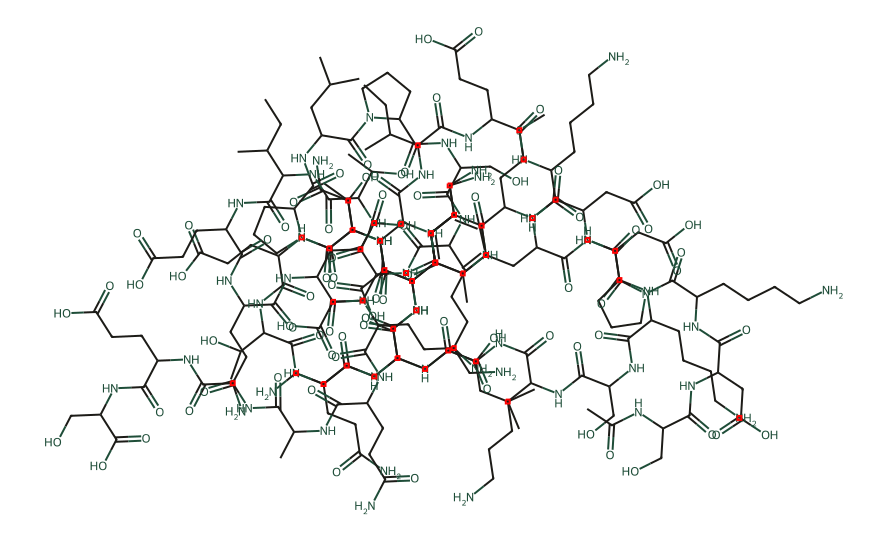
2D structure · PubChem record, redrawn
Amino-acid sequence
- * Native mature thymosin beta-4 is N-terminally acetylated (UniProt P62328); the acetylation status of research TB-500 vials is not independently verified
Sequence per UniProt P62328 (thymosin beta-4, mature chain).
Dose ranges
Study-backed ranges carry a source you can open. Community ranges are widely reported but not clinically established - treat them as what people do, not as advice.
Preclinical - human Phase 1 IV safety study, whole Thymosin Beta-4 (not the self-injected fragment; route and scale differ sharply from community use)
study42-1260 mg
single ascending dose, then daily for 14 days
General injury recovery / soft-tissue support, TB-500 alone (community protocol)
community2-2.5 mg
1-2x per week, subcutaneous
Loading then maintenance, in a TB-500 + BPC-157 stack (community protocol)
community1.25 mg
2x/week weeks 1-4 (loading), then 1x/week weeks 5-12
Reconstitution & storage
5 mg is the vial size that shows up consistently in community guides. 1 mL bacteriostatic water gives 5 mg/mL, 2 mL gives 2.5 mg/mL. None of this comes from a clinical or manufacturer monograph - it is vendor and community convention.
Lyophilized
Refrigerate at 2-8C (36-46F), protected from light. Community sources give no precise expiration for the powder.
Reconstituted
Refrigerate at 2-8C after mixing; community guides converge on ~28-30 days of usable stability. Avoid freeze-thaw cycling.
Ships as a white lyophilized powder cake in a 3 mL glass vial (5 mg sizes are typical), reconstituted with bacteriostatic water before use.
Run the numbers in the calculatorStacks and pairings
Interactions & cautions
No formal human drug-interaction studies exist for TB-500 or injected Thymosin Beta-4, so nothing here is clinically confirmed. Mechanism-based cautions: avoid with active cancer or a cancer history (Tb4 promotes blood-vessel growth, which could in theory feed tumors), and avoid in pregnancy or breastfeeding (unstudied). TB-500 and Tb4 derivatives are on the WADA prohibited list. The FDA lists the TB-500 fragment (sequence LKKTETQ) among bulk substances with safety data too limited for compounding. The biggest practical risk is often the unregulated product itself - contamination, mislabeling, or wrong concentration.
Questions people ask
Is TB-500 the same thing as Thymosin Beta-4?
No. Thymosin Beta-4 is the full natural 43-amino-acid protein. TB-500 is a lab-made 7-amino-acid piece of it. Most research, including every human clinical trial, was done on the full protein, not the TB-500 fragment.
Has TB-500 been tested in human clinical trials?
Not the injectable fragment. The full Tb4 molecule has real human trials (an IV safety study, and dry-eye eye drops), but none used the fragment, dose, or injection route common in TB-500 self-use.
Where do the '2 to 2.5 mg twice a week' protocols come from?
From online peptide communities and vendor guides, not a published dose-finding study. Several of those guides say so outright. Treat any TB-500 injection protocol as community convention, not an established dose.
Is TB-500 banned in sports?
Yes. It is prohibited by the World Anti-Doping Agency, so athletes subject to WADA testing cannot use it. It is not an FDA-approved drug for any indication.
Sources
- [1]Biodistribution of synthetic thymosin beta 4 in the serum, urine, and major organs of mice PMID 9226473studyIn mice given thymosin beta-4 IP, serum rose within 2 minutes and cleared within about 40 minutes via rapid renal excretion.
- [2]Thymosin beta4: actin-sequestering protein moonlights to repair injured tissues PMID 16099219studyThymosin beta-4 is the major actin-sequestering peptide in cells, underlying its role in wound healing and tissue repair.
- [3]Muscle injury-induced thymosin beta4 acts as a chemoattractant for myoblasts PMID 20880960studyAfter muscle injury in mice, locally produced thymosin beta-4 attracted myoblasts to the injury site and accelerated their migration.
- [4]A randomized, placebo-controlled, single and multiple dose study of intravenous thymosin beta4 in healthy volunteers PMID 20536472studyIV thymosin beta-4 at 42-1260 mg was well tolerated in healthy humans with dose-proportional pharmacokinetics and half-life increasing at higher doses.
- [5]Thymosin beta 4 ophthalmic solution for dry eye: a randomized, placebo-controlled Phase II trial PMID 26056426study0.1% thymosin beta-4 eye drops produced statistically significant improvement in corneal staining in dry-eye patients versus vehicle.
- [6]Thymosin Beta-4 and TB-500 in Tissue Healing: A Scoping Review (2026)studyHuman evidence exists for whole Thymosin Beta-4 in ocular and wound settings; direct human evidence for the TB-500 fragment was limited to a single non-musculoskeletal study. Notes FDA lists LKKTETQ as a bulk substance of concern and WADA prohibits TB4/TB-500.
- [7]TB-500 & BPC-157 Stacking: Dosing Protocols (community guide)communityCommunity guide reporting a 5 mg TB-500 vial with 1 mL bacteriostatic water, dosed ~2-2.5 mg 1-2x weekly; states outright that no human dosing or PK study supports these numbers.
What we could not verify
A precise measured half-life for the TB-500 fragment itself does not exist in the literature; online figures are estimates. Closest real data is on full Thymosin Beta-4 (mouse ~40 min clearance; human IV dose-proportional). Vial sizes other than 5 mg were not independently confirmed. All interaction cautions are mechanism-based extrapolations plus FDA/WADA listings, not clinical findings.
Keep reading
Pepteca is for education and information only. It does not provide medical advice, diagnosis, or treatment, and its calculators perform unit math only. Always verify with a licensed provider before starting, changing, or stopping any protocol. Many peptides are not approved for human use and may be regulated differently where you live.