cat. no. TESAMORELIN
Tesamorelin: dosage, half-life and storage
Synthetic 44-amino-acid growth hormone-releasing hormone (GHRH) analog (a growth hormone secretagogue), given by subcutaneous injection
also: Egrifta / Egrifta SV / Egrifta WR / TH9507 / tesamorelin acetate
By An NayalLast reviewed 10 sources
At a glance
On this card (8)
What it is
Tesamorelin is a synthetic 44-amino-acid analog of growth hormone-releasing hormone (GHRH), sold under the brand names Egrifta SV and Egrifta WR. It is FDA-approved for one specific, narrow use: reducing excess abdominal fat in HIV-infected adults with lipodystrophy caused by antiretroviral therapy (the fat depot measured in its trials is visceral adipose tissue). The label explicitly states it is not indicated for general weight loss and does not improve antiretroviral adherence. Mechanistically, it binds pituitary GHRH receptors to stimulate the body's own pulsatile growth hormone release, raising IGF-1 and promoting lipolysis of visceral fat. The evidence base for the approved indication is unusually solid for a peptide drug: the pivotal Falutz et al. 2007 NEJM trial (412 patients, 26 weeks) found a 15.2 percent reduction in visceral adipose tissue versus a 5.0 percent increase with placebo, with IGF-1 rising 81 percent; a pooled analysis of two phase 3 trials showed the fat reduction sustained through 52 weeks. It is cleared very quickly, with a single-dose half-life of 8 to 11 minutes reported on current FDA labels, and under 4 percent subcutaneous bioavailability. It must be reconstituted from lyophilized powder before each injection. Outside the approved indication, tesamorelin is discussed in anti-aging and fitness communities for general visceral fat reduction, an off-label use not supported by the same trial evidence.
The molecule
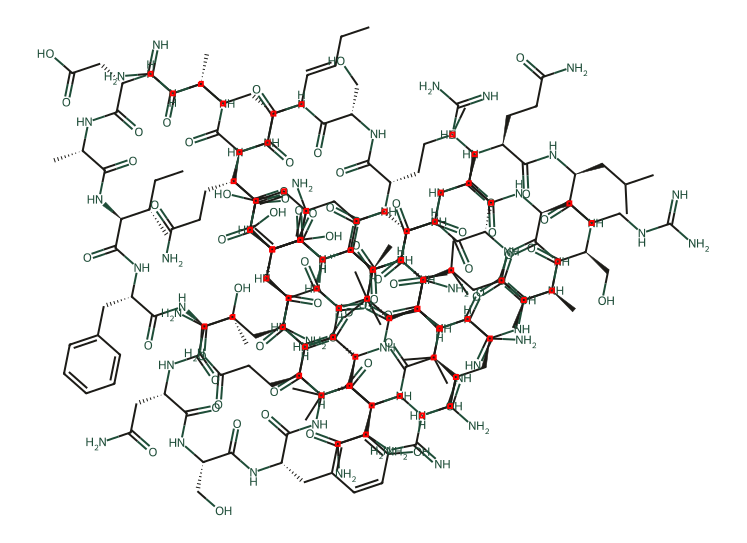
2D structure · PubChem record, redrawn
Amino-acid sequence
- * Tyr1 alpha-amino acylated with a trans-3-hexenoyl group
- * C-terminus amidated (Leu44-NH2)
Sequence per FDA EGRIFTA prescribing information.
Dose ranges
Study-backed ranges carry a source you can open. Community ranges are widely reported but not clinically established - treat them as what people do, not as advice.
FDA-approved dose, Egrifta SV (current formulation, 2 mg vial)
study1.4 mg
once daily, subcutaneous injection into the abdomen
FDA-approved dose, Egrifta WR (current formulation, 11.6 mg multi-dose vial)
study1.28 mg
once daily, subcutaneous injection into the abdomen
Pivotal phase 3 trial dose (original 1 mg/vial formulation; Falutz et al. 2007 NEJM and the pooled phase 3 analysis)
study2 mg
once daily, subcutaneous injection
Community-reported off-label use (anti-aging, fitness, body-recomposition contexts outside the FDA-approved HIV lipodystrophy population)
community1 to 2 mg
once daily, subcutaneous, often described in 8 to 26 week cycles with breaks
Reconstitution & storage
Two current, non-interchangeable commercial formulations. Egrifta SV: 2 mg lyophilized powder in a single-dose vial, reconstituted with 0.5 mL Sterile Water for Injection (roll gently 30 seconds, do not shake) to give 2 mg/0.5 mL; withdraw 0.35 mL (1.4 mg) for the daily dose; administer immediately and discard any unused solution (do not freeze or refrigerate). Egrifta WR: 11.6 mg lyophilized powder in a multi-dose vial, reconstituted with 1.3 mL Bacteriostatic Water for Injection, USP (swirl, do not shake) to give approximately 8 mg/mL; withdraw 0.16 mL (1.28 mg) once daily; one reconstituted vial supplies 7 daily doses and may be kept at room temperature for up to 7 days. The original 1 mg/vial Egrifta formulation (studied in the pivotal trials at a 2 mg/day dose, i.e. two vials) appears to have been discontinued in favor of SV and WR; this discontinuation was not independently verified against a primary source during this research. Source: DailyMed labels for Egrifta SV and Egrifta WR.
Lyophilized
Store unreconstituted vials at 20 to 25 C (68 to 77 F), room temperature, with excursions permitted to 15 to 30 C (59 to 86 F). Egrifta WR should be kept in its original box to protect from light.
Reconstituted
Egrifta SV: administer immediately after reconstitution; discard any unused solution and diluent; do not freeze or refrigerate. Egrifta WR: the reconstituted multi-dose vial may be stored and used for up to 7 days; do not freeze.
Ships as a white lyophilized powder cake in a 3 mL glass vial (2, 11.6 mg sizes are typical), reconstituted with bacteriostatic water before use.
Run the numbers in the calculatorStacks and pairings
Interactions & cautions
The FDA label warns that because tesamorelin raises growth hormone, it may alter the clearance of drugs metabolized by cytochrome P450 liver enzymes, including corticosteroids, sex steroids, anticonvulsants, and cyclosporine, so concomitant use should be monitored. Patients on glucocorticoid replacement for previously diagnosed hypoadrenalism may need an increased maintenance or stress dose after starting tesamorelin. Tesamorelin also raises IGF-1 (about 81 percent in the tesamorelin group in the pivotal trial, versus a slight decline with placebo) and is associated with a higher rate of new or worsening glucose intolerance and elevated HbA1c than placebo, which is relevant for patients on antidiabetic therapy. In clinical trials, anti-tesamorelin IgG antibodies developed in about 50 percent of patients by 26 weeks and 47 percent by 52 weeks, with roughly 60 percent of those showing cross-reactivity to endogenous GHRH; the clinical significance of this immunogenicity was not fully characterized in the label. Source: DailyMed Egrifta SV and Egrifta WR labels, Drug Interactions and Warnings sections.
Questions people ask
What is tesamorelin FDA-approved to treat?
Reducing excess abdominal fat in HIV-infected adults with lipodystrophy (the abnormal fat redistribution associated with antiretroviral therapy); the specific fat depot measured in the trials and monitored on the label is visceral adipose tissue. The label states it is not indicated for general weight loss, has a weight-neutral effect overall, and does not improve compliance with antiretroviral therapy. Long-term cardiovascular safety has not been established.
How is tesamorelin dosed and administered under the FDA label?
As a subcutaneous injection once daily into the abdomen, with rotating injection sites. The two current products are dosed differently because they are separate reformulations: Egrifta SV delivers 1.4 mg (0.35 mL) reconstituted from a 2 mg vial with 0.5 mL sterile water; Egrifta WR delivers 1.28 mg (0.16 mL) reconstituted from an 11.6 mg multi-dose vial with 1.3 mL bacteriostatic water, giving 7 daily doses per vial. The original pivotal trials used a 2 mg daily dose of an earlier, apparently discontinued, 1 mg/vial formulation.
What is tesamorelin's half-life?
The current FDA labels report a mean elimination half-life of 8 minutes (Egrifta SV) and 11 minutes (Egrifta WR) after a single subcutaneous dose in healthy subjects. Some secondary and community sources cite a longer 26 to 38 minute range, reportedly from multiple-dose data on the original formulation, but this could not be verified against a primary source that was accessible during this research.
Does tesamorelin affect IGF-1?
Yes, substantially. By stimulating pituitary growth hormone release, it raises IGF-1; in the pivotal 26-week trial, IGF-1 rose 81 percent in the tesamorelin group, versus a slight decline with placebo. The FDA label recommends monitoring IGF-1 during treatment and considering discontinuation with persistent elevations (for example, more than 3 standard deviations above normal), particularly if the efficacy response is not robust.
Who should not use tesamorelin?
The label lists contraindications for pregnancy, active malignancy, known hypersensitivity to tesamorelin or its excipients, and disruption of the hypothalamic-pituitary axis (from pituitary tumor, surgery, irradiation, or head trauma). It also advises considering discontinuation in patients who develop acute critical illness, reflecting a mortality signal associated with pharmacologic growth hormone in that setting.
Is tesamorelin used outside its approved HIV indication?
Yes, informally. Anti-aging and fitness communities discuss tesamorelin for general visceral fat reduction, body recomposition, and growth hormone support, sometimes at lower doses (for example around 1 mg/day) than the approved regimen. This use is off-label, was not studied in the pivotal trials (which enrolled only HIV-positive patients with lipodystrophy), and is community-reported only, not clinically established for that population.
Sources
- [1]EGRIFTA SV (tesamorelin) for injection - full prescribing informationlabelFDA-approved indication, dose (1.4 mg SC once daily), reconstitution steps, contraindications, warnings (malignancy, IGF-1, HPA axis, critical illness, glucose intolerance), adverse reaction rates, immunogenicity, drug interactions, and single-dose pharmacokinetics (8-minute half-life) for Egrifta SV.
- [2]EGRIFTA WR (tesamorelin) for injection - full prescribing informationlabelEgrifta WR dose (1.28 mg SC once daily), reconstitution with bacteriostatic water from an 11.6 mg multi-dose vial (7-day use), storage, and single-dose pharmacokinetics (11-minute half-life).
- [3]Metabolic effects of a growth hormone-releasing factor in patients with HIV (Falutz et al., N Engl J Med 2007) PMID 18057338studyPivotal 26-week phase 3 trial (n=412, 2 mg/day of the original formulation): 15.2 percent visceral adipose tissue reduction versus a 5.0 percent increase with placebo, and an 81 percent increase in IGF-1.
- [4]Effects of tesamorelin (TH9507), a growth hormone-releasing factor analog, in HIV-infected patients with excess abdominal fat: a pooled analysis of two phase 3 trials with safety extension data (Falutz et al., J Clin Endocrinol Metab 2010) PMID 20554713studyPooled analysis of the two pivotal phase 3 trials showing visceral fat reduction sustained through 52 weeks, preserved subcutaneous fat, improved lipids, and overall tolerability without clinically meaningful glucose changes.
- [5]Effect of tesamorelin on visceral fat and liver fat in HIV-infected patients with abdominal fat accumulation: a randomized clinical trial (Stanley et al., JAMA 2014) PMID 25038357studyIndependent 6-month RCT (n=50) showing tesamorelin reduced both visceral fat and liver fat versus placebo, with a transient fasting glucose increase at 2 weeks that normalized by month 6.
- [6]Tesamorelin - LiverTox: Clinical and Research Information on Drug-Induced Liver Injury (NCBI Bookshelf)review2010 FDA approval date, mechanism-of-action summary, and hepatotoxicity likelihood category E (unlikely cause of clinically apparent liver injury; no reported cases).
- [7]Introduction - Clinical Review Report: Tesamorelin (Egrifta) (CADTH, via NCBI Bookshelf)reviewHealth-technology-assessment description of mechanism, patient-selection criteria (waist circumference and CT-confirmed visceral fat thresholds), and the 2 mg/day trial dose.
- [8]References - Clinical Review Report: Tesamorelin (Egrifta) (CADTH, via NCBI Bookshelf)referenceConfirms the second pivotal phase 3 trial (CTR-1011, n=404) exists only as an unpublished, confidential manufacturer clinical study report rather than an independently accessible peer-reviewed paper, and gives the Falutz 2007 and Stanley 2014 citations.
- [9]Tesamorelin | C221H366N72O67S | CID 16137828 (PubChem)referenceMolecular formula (C221H366N72O67S) and PubChem compound identity (CID 16137828) for tesamorelin free base.
- [10]Tesamorelin Peptide Guide: Benefits, Uses, Dosage, Bodybuilding (Muscle & Brawn)communityIllustrates community and off-label dosing discourse (for example 1 to 2 mg/day, 12 to 26 week cycles) for anti-aging and bodybuilding use outside the FDA-approved HIV indication; not clinical evidence.
What we could not verify
Could not verify: a widely repeated secondary/community claim (Wikipedia and several peptide-vendor sites) that tesamorelin's mean elimination half-life is 26 to 38 minutes (attributed to multiple-dose, 14-day steady-state data in healthy subjects versus HIV-infected patients, apparently from the original 1 mg/vial formulation). The current DailyMed labels for Egrifta SV and Egrifta WR only report single-dose half-lives of 8 and 11 minutes respectively for the current reformulated products, and do not contain multiple-dose PK data. The likely primary source for the 26-38 minute figure, the FDA clinical pharmacology review (accessdata.fda.gov), returned HTTP 403 Forbidden when fetched directly, and drugs.com's mirror of the full prescribing information also returned 403. This figure is reported here only in the FAQ with an explicit caveat, and is not used in the half_life field. Could not verify: the exact standalone peer-reviewed citation for the second pivotal phase 3 trial (CTR-1011, n=404, referenced in secondary sources as a 26-week confirmatory trial with roughly 14 percent versus 2 percent VAT reduction); per the CADTH clinical review report this trial appears to exist only as a confidential, unpublished manufacturer clinical study report, so it is represented here through the peer-reviewed pooled analysis (Falutz 2010, JCEM) instead of being cited directly. Could not verify: that the original 1 mg/vial Egrifta formulation has been formally discontinued; this is inferred circumstantially from its absence in the current DailyMed search results (only Egrifta SV and Egrifta WR are listed) and from unfetched secondary sources, not from a directly fetched discontinuation notice. Could not verify: claims (seen repeated across multiple community/vendor sites and in one WADA-focused search snippet) that tesamorelin and other GHRH analogs are listed as prohibited substances under WADA's S2 category; direct fetch attempts of wada-ama.org (returned blank content) and a drugs.com mirror (403 Forbidden) did not resolve with readable supporting content, so this claim is omitted from the JSON entirely rather than included as community-sourced. Confirmed and explicitly stated on the DailyMed label (not a gap, but worth flagging): pharmacokinetics in patients with renal or hepatic impairment, in pediatric patients, or in elderly patients have not been established. No USP monograph for tesamorelin was located or checked in depth during this research.
Keep reading
Pepteca is for education and information only. It does not provide medical advice, diagnosis, or treatment, and its calculators perform unit math only. Always verify with a licensed provider before starting, changing, or stopping any protocol. Many peptides are not approved for human use and may be regulated differently where you live.