cat. no. SERMORELIN
Sermorelin: dosage, half-life and storage
Synthetic 29-amino-acid analog of human growth-hormone-releasing hormone (GHRH(1-29)-NH2); a GHRH-receptor agonist and growth hormone secretagogue, given by subcutaneous injection.
also: Sermorelin acetate / GHRH(1-29)-NH2 / GRF(1-29)-NH2 / Geref (discontinued brand)
By An NayalLast reviewed 17 sources
At a glance
On this card (8)
What it is
Sermorelin is a synthetic 29-amino-acid peptide matching the biologically active fragment of human growth-hormone-releasing hormone (GHRH). Rather than supplying growth hormone directly, it signals the pituitary to release its own GH in short pulses, which only works if the pituitary is otherwise intact. It has a genuine regulatory history: as Geref, it was FDA-approved, first in 1990 as an intravenous diagnostic test of GH reserve, then in 1997 as a nightly subcutaneous treatment for confirmed GH deficiency in children. Its manufacturer, EMD Serono, discontinued Geref in 2008, and the FDA explicitly determined this was for business reasons unrelated to safety or effectiveness. No FDA-approved sermorelin product exists today, DailyMed carries no current label, and the GHRH-arginine diagnostic test built around it has been commercially unavailable in the United States ever since. Everything sold now is compounded by 503A or 503B pharmacies, a different and less rigorous pathway than an approved drug. Human pharmacokinetic studies consistently show it clears from plasma within minutes. The 200-300 mcg nightly regimen widely marketed for adult 'growth hormone optimization' or anti-aging use is a compounding-clinic and community convention, not a dose tested in the small, decades-old published adult GHRH trials, and no major endocrine society currently endorses GHRH therapy for anti-aging in healthy adults.
The molecule
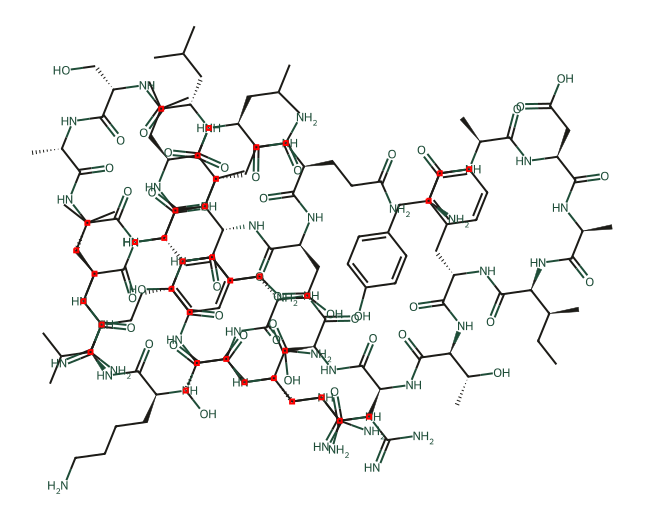
2D structure · PubChem record, redrawn
Amino-acid sequence
- * C-terminus amidated (Arg29-NH2)
Sequence per PubChem CID 16132413.
Dose ranges
Study-backed ranges carry a source you can open. Community ranges are widely reported but not clinically established - treat them as what people do, not as advice.
Diagnostic GHRH stimulation test of pituitary GH reserve (historical FDA-approval-era protocol)
study1 mcg/kg IV, single dose
single diagnostic dose
Historical FDA-approved pediatric treatment (Geref, for confirmed idiopathic growth hormone deficiency in children; product discontinued 2008)
study30 mcg/kg subcutaneous
once daily at bedtime
1990s randomized studies of GHRH(1-29) in healthy older adults (research dosing from small trials; not the same as current community protocols)
study500-2000 mcg subcutaneous
nightly for 6 weeks (Vittone 1997) or twice daily for 14 days (Corpas 1992)
Adult 'growth hormone optimization' or anti-aging use through compounding pharmacies and telehealth clinics (off-label; not an FDA-approved use)
community200-300, occasionally up to 500 mcg subcutaneous
nightly, often cycled 5 days on / 2 days off
Reconstitution & storage
Compounded sermorelin is dispensed as a lyophilized powder in multi-dose vials, commonly 6-15 mg, and reconstituted with bacteriostatic water for injection, commonly at roughly a 2 mg/mL ratio (for example 6 mg plus 3 mL, 9 mg plus 4.5 mL, 15 mg plus 7.5 mL), though some compounders instead formulate at about 1 mg/mL. Exact vial size, diluent volume, and final concentration vary by compounding pharmacy, so the pharmacy's own label and instructions govern. Add diluent gently against the vial wall and swirl (do not shake); the reconstituted solution should be clear and colorless, and should not be used if cloudy or if particles are visible. Note that the original FDA-approved Geref label specified reconstitution with Sodium Chloride Injection, USP (saline), not bacteriostatic water; bacteriostatic water is the diluent used in current compounded practice, which allows the multi-dose vial to be used over multiple days.
Lyophilized
Refrigerate at 2-8 C (36-46 F). The original Geref label specified refrigerated storage for the unreconstituted vial, and compounding pharmacies give the same instruction for lyophilized compounded sermorelin.
Reconstituted
Community and compounding-pharmacy guidance is to keep the reconstituted vial refrigerated (2-8 C) and use it within a pharmacy-assigned beyond-use date, commonly cited as up to about 90 days refrigerated, with brief room-temperature excursions (well under 72 hours) generally tolerated. This beyond-use dating is set by the individual compounding pharmacy rather than by an FDA label, so it varies; always follow the specific pharmacy's printed instructions rather than a generic figure.
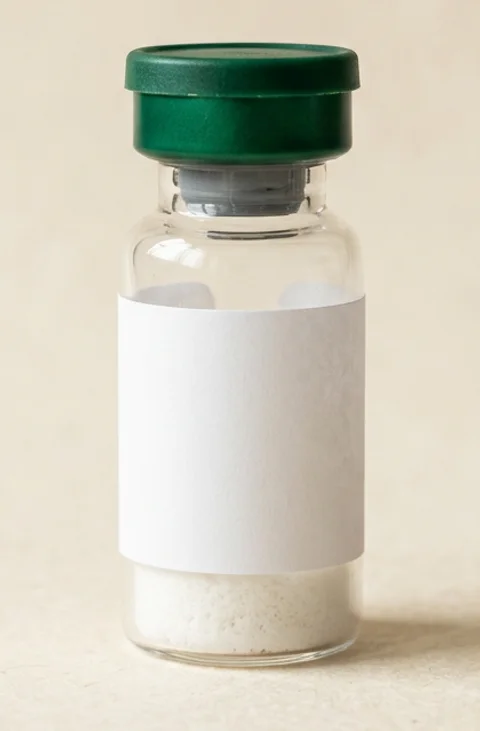
Ships as a white lyophilized powder cake in a 3 mL glass vial (6, 9, 15 mg sizes are typical), reconstituted with bacteriostatic water before use.
Run the numbers in the calculatorStacks and pairings
Interactions & cautions
Sermorelin's own historical FDA labeling, preserved in secondary drug references because DailyMed no longer carries a current sermorelin or Geref label, states that concomitant glucocorticoid (corticosteroid) therapy may blunt the GH response to sermorelin, and that patients with GH deficiency caused by an intracranial lesion were not studied in the original clinical trials, so treatment is 'not recommended' in that population. The same labeling recommends baseline and on-therapy thyroid function testing, since hypothyroidism occurred in about 6.5 percent of clinical-study patients, and lists it as Pregnancy Category C with no data on excretion into breast milk. Because sermorelin works upstream of growth hormone and requires an intact pituitary, it has not been independently confirmed to carry the same formal active-malignancy contraindication that appears on recombinant growth hormone (somatropin) labeling. Reviewers nonetheless commonly flag a theoretical, class-level concern: any therapy that raises GH and IGF-1 signaling could in principle support the growth of an existing tumor, so many prescribers extend the same caution used for GH therapy generally, even though this has not been specifically trial-tested for sermorelin. No controlled drug-drug interaction studies for compounded sermorelin were found in the modern literature. Combining sermorelin with other growth-hormone secretagogues or with recombinant GH itself ('stacking') is common in community and compounding-clinic practice but has not been evaluated in controlled trials.
Questions people ask
Is sermorelin FDA-approved?
Not as a currently marketed product. Its only FDA-approved form, Geref, was approved in 1990 for diagnostic use and in 1997 for pediatric growth hormone deficiency treatment, then discontinued by the manufacturer in 2008 for business reasons the FDA stated were unrelated to safety or effectiveness. DailyMed lists no current label, so sermorelin sold today is compounded, not FDA-approved.
How long does sermorelin stay in the body?
Not long. Published human studies put its elimination half-life at roughly 10-20 minutes, with estimates ranging from about 4 minutes to 11-12 minutes depending on the study and method, which is consistent with it producing a short pulse of GH release rather than a sustained elevation.
What is the GHRH stimulation test?
It is sermorelin's original diagnostic use: an intravenous dose (historically about 1 mcg/kg) given with timed blood draws to see whether the pituitary can still release growth hormone. The version of this test that combined GHRH with arginine has not been commercially available in the United States since Geref was discontinued in 2008.
What dose was used to treat growth-hormone-deficient children when Geref was on the market?
The FDA-approval-era literature describes a regimen of 30 mcg/kg given subcutaneously once daily at bedtime for children with confirmed idiopathic growth hormone deficiency.
What dose do adults commonly use for 'growth hormone optimization'?
Compounding pharmacies and telehealth clinics commonly cite 200-300 mcg nightly, occasionally up to 500 mcg, but this is a community and clinical convention rather than a dose validated by a randomized controlled trial in adults. It is also lower than the 0.5-2 mg doses used in the small published adult GHRH studies from the 1990s.
Is combining sermorelin with other peptides ('stacking') supported by evidence?
It is common in community and compounding-clinic practice, but no controlled trials evaluating such combinations were found. There is no clinical evidence describing the safety or added effect of stacking sermorelin with other growth-hormone secretagogues or with growth hormone itself.
Sources
- [1]Determination That GEREF (Sermorelin Acetate) Injection Products Were Not Withdrawn From Sale for Reasons of Safety or Effectiveness (Federal Register, via GovInfo)regulatoryConfirms Geref (sermorelin acetate) NDA approval dates (December 1990 and September 1997), EMD Serono's 2008 discontinuation letters, and FDA's determination that withdrawal was not for reasons of safety or effectiveness.
- [2]DailyMed search results for 'sermorelin' and 'geref' (0 results)regulatoryConfirms no current FDA drug label is listed on DailyMed for sermorelin or Geref, corroborating that no FDA-approved sermorelin product is currently marketed.
- [3]Growth hormone-releasing factor analogue (hGRF1-29NH2): immunoreactive-GRF plasma levels after intravenous and subcutaneous administration (Rafferty et al., J Endocrinol, 1985) PMID 2866222studyRat pharmacokinetic study (not human) reporting an initial distribution-phase half-life of 1.9 min and an elimination-phase half-life of 10.4 min for GRF(1-29)-NH2 after IV dosing, plus only about 4% relative bioavailability after subcutaneous dosing.
- [4]Incorporation of D-Ala2 in growth hormone-releasing hormone-(1-29)-NH2 increases the half-life and decreases metabolic clearance in normal men (Soule et al., J Clin Endocrinol Metab, 1994) PMID 7962295studyHuman constant-IV-infusion study in 10 healthy men reporting a disappearance half-time of 4.3 +/- 1.4 minutes for unmodified GHRH-(1-29)-NH2, the active sequence in sermorelin.
- [5]PEGylation of growth hormone-releasing hormone (GRF) analogues (Esposito et al., Adv Drug Deliv Rev, 2003) PMID 14499707reviewStates that native GRF(1-29) (sermorelin) has 'a short half-life in plasma, about 10-20 min in humans.'
- [6]Sermorelin: a review of its use in the diagnosis and treatment of children with idiopathic growth hormone deficiency (Prakash and Goa, BioDrugs, 1999) PMID 18031173reviewReports the FDA-approval-era diagnostic dose (intravenous sermorelin 1 mcg/kg bodyweight) and the pediatric treatment dose (subcutaneous sermorelin 30 mcg/kg bodyweight once daily at bedtime) for idiopathic growth hormone deficiency.
- [7]Pharmacokinetics of growth hormone-releasing hormone(1-29)-NH2 and stimulation of growth hormone secretion in healthy subjects after intravenous or intranasal administration (Wilton et al., Acta Paediatr Suppl, 1993) PMID 8329825studyHuman dose-response study in 30 healthy men showing IV doses from 0.25 to 2 mcg/kg stimulate GH release (maximal response around 1-2 mcg/kg) and that GHRH(1-29)-NH2 is rapidly eliminated after IV injection.
- [8]Sermorelin: a better approach to management of adult-onset growth hormone insufficiency? (Walker, Clin Interv Aging, 2006) PMID 18046908reviewConfirms, via title and indexed bibliographic metadata, that management of adult-onset growth hormone insufficiency with sermorelin has been discussed as an editorial position in the peer-reviewed literature; full text/abstract could not be independently retrieved beyond title and metadata.
- [9]Effects of single nightly injections of growth hormone-releasing hormone (GHRH 1-29) in healthy elderly men (Vittone et al., Metabolism, 1997) PMID 9005976studyRCT giving healthy elderly men 2 mg GHRH(1-29) subcutaneously nightly for 6 weeks; increased nocturnal GH release and peak amplitude but did not significantly change IGF-I, IGFBP-3, or DEXA body composition measures.
- [10]Growth hormone (GH)-releasing hormone-(1-29) twice daily reverses the decreased GH and insulin-like growth factor-I levels in old men (Corpas et al., J Clin Endocrinol Metab, 1992) PMID 1379256studyRCT in old men (mean age 68) using 0.5 mg and 1 mg GHRH(1-29) subcutaneously twice daily for 14 days; the 1 mg dose normalized 24-hour GH and IGF-I levels toward young-adult values, with no significant effect on fasting glucose, blood pressure, or hematology.
- [11]Sermorelin Acetate drug monograph (RxList)referenceSecondary compilation that mirrors the original Geref/sermorelin FDA label (dated 10/2/2001): elimination half-life 11-12 minutes after IV or subcutaneous dosing, clearance 2.4-2.8 L/min, about 6% subcutaneous bioavailability, glucocorticoids may blunt the GH response, hypothyroidism occurred in 6.5% of clinical-study patients, Pregnancy Category C, and treatment 'not recommended' in growth hormone deficiency secondary to an intracranial lesion.
- [12]Hormones and Aging: An Endocrine Society Scientific Statement (Cappola et al., J Clin Endocrinol Metab, 2023;108(8):1835-1874)reviewEndocrine Society consensus statement concluding that 'no therapy to increase GH secretion or action is approved as an anti-aging intervention' and that 'there are no approved therapies for reversing the age-associated decline of GH secretion.'
- [13]Growth Hormone Stimulation Tests in Assessing Adult Growth Hormone Deficiency (Yuen, in Endotext, NCBI Bookshelf NBK395585, updated 2023)reviewStates that EMD Serono discontinued manufacturing the GHRH analog (Geref) in November 2008, and that the GHRH-arginine stimulation test has consequently not been commercially available in the United States since then.
- [14]Sermorelin Acetate Injection (compounding pharmacy product page, Empower Pharmacy)communityCompounding-pharmacy source describing typical compounded vial sizes (6, 9, and 15 mg), bacteriostatic water as the reconstitution diluent, and commonly cited adult (0.2-0.3 mg nightly) and pediatric (about 30 mcg/kg) dosing conventions.
- [15]Medication and Injection Instructions for Sermorelin (Defy Medical)communityPatient-instruction source giving specific bacteriostatic-water reconstitution ratios (6 mg/3 mL, 9 mg/4.5 mL, 15 mg/7.5 mL) and a commonly cited post-reconstitution refrigerated storage window of up to 90 days, with short room-temperature excursions under about 72 hours described as tolerated.
- [16]Compounded Sermorelin for Clinical Practice: A Practitioner's Guide (Strive Pharmacy)communityCompounding-pharmacy provider guide citing a 1 mg/mL formulation and an adult dosing convention of 0.15-0.3 mL (150-300 mcg) subcutaneously nightly, 5 of 7 days per week.
- [17]Sermorelin (Wikipedia)communityTertiary cross-check for aliases (GHRH(1-29), GRF 1-29, sermorelin acetate) and the general regulatory-history summary; used only to corroborate facts independently verified in the primary and secondary sources above, not as a standalone source for any numeric claim.
What we could not verify
Could not verify via DailyMed: a direct search of DailyMed for both 'sermorelin' and 'geref' returned zero results, so there is no current FDA-approved label to cite; all label-style pharmacokinetic and precaution figures in this profile (half-life 11-12 minutes, clearance 2.4-2.8 L/min, about 6% subcutaneous bioavailability, hypothyroidism incidence, intracranial-lesion caution, glucocorticoid interaction) come from RxList's secondary mirror of the historical Geref label rather than from a primary document opened directly. Direct attempts to reach fda.gov, accessdata.fda.gov, drugs.com, and web.archive.org all failed (403 Forbidden or fetch blocked in this environment), so the original PDF package insert could not be opened directly; PDR.net loaded but returned no drug-specific content. pubmed.ncbi.nlm.nih.gov itself was blocked by a cookie-consent wall for every PMID checked; all PubMed-indexed studies cited here were instead verified through the Europe PMC REST API, which mirrors PubMed abstracts, per the source-preference fallback. Could not verify a specific numeric dose for the modern GHRH-arginine adult stimulation test protocol beyond the original approximately 1 mcg/kg IV diagnostic dose from the 1990s pediatric-era literature, because the test has been commercially unavailable in the United States since 2008. Vendor and SEO blog content (for example TrimRX, Newtropin) claims a 'January 2026 FDA guidance' requiring prescribers to document medical necessity before prescribing compounded sermorelin; this could not be corroborated against any Federal Register, GovInfo, or FDA document opened in this research and is treated as unverified and is not included as fact anywhere in this profile. Sermorelin's current (2026) status on FDA's 503A bulk-substance category lists could not be independently confirmed because fda.gov could not be fetched directly; secondary sources describe it as not currently subject to the Category 2 restrictions applied to some other compounded peptides (for example CJC-1295, ipamorelin), but this is community-level information only, not independently verified here. The adult 200-300 mcg nightly 'GH optimization' dose is a community and compounding-clinic convention repeated across many vendor and clinic websites; it is not the dose used in the small 1990s peer-reviewed aging studies identified here (which used 0.5-2 mg), and no randomized controlled trial of this specific lower community dose in adults was found. Could not verify a sermorelin-specific, trial-confirmed statement that sermorelin is formally contraindicated in active malignancy (as recombinant growth hormone/somatropin labeling is); this is presented in interactions_notes as a hedged, class-level theoretical concern rather than a sermorelin-specific finding. PubChem's CID 16132413 record for 'Sermorelin' returns an IUPAC name ending in a free carboxylic acid, whereas sermorelin's defining feature is a C-terminal amide (GHRH(1-29)-NH2); this may indicate the PubChem entry represents a des-amide/free-acid form rather than the marketed amide, so no molecular-weight or formula figure from PubChem is asserted anywhere in this profile. Could not access PMC12009952 ('Growth hormone and aging: a clinical review') due to a CAPTCHA block, and the Endocrine Society statement's own PDF was unreadable (encrypted/binary); the Oxford Academic HTML version of the same statement was used instead and did resolve with readable, quotable text.
Keep reading
Pepteca is for education and information only. It does not provide medical advice, diagnosis, or treatment, and its calculators perform unit math only. Always verify with a licensed provider before starting, changing, or stopping any protocol. Many peptides are not approved for human use and may be regulated differently where you live.