cat. no. PT-141
PT-141 (Bremelanotide): dosage, half-life and storage
Synthetic cyclic heptapeptide melanocortin receptor agonist (MC1R/MC4R); FDA-approved as a subcutaneous injection (brand name Vyleesi) for hypoactive sexual desire disorder in premenopausal women
also: Bremelanotide / Bremelanotide acetate / Vyleesi / PT 141
By An NayalLast reviewed 11 sources
At a glance
On this card (8)
What it is
PT-141, also known as bremelanotide, is a synthetic cyclic peptide that activates melanocortin receptors (chiefly MC1R and MC4R) rather than acting directly on blood vessels the way PDE5 inhibitors do. The FDA approved it in 2019 under the brand name Vyleesi as a 1.75 mg subcutaneous injection, self-administered via a single-use prefilled autoinjector, for acquired, generalized hypoactive sexual desire disorder (HSDD) in premenopausal women. It is taken on demand, at least 45 minutes before anticipated sexual activity, with a maximum of one dose per 24 hours and eight doses per month. Two identical phase 3 trials (the RECONNECT program, over 1,200 women) found statistically significant, though modest, improvements in desire and desire-related distress compared with placebo. Notably, the FDA label itself states that the exact mechanism by which Vyleesi improves HSDD is unknown. Common effects include nausea (about 40% of patients), flushing, injection-site reactions, and headache, plus a transient rise in blood pressure and drop in heart rate after each dose. Outside the approved product, PT-141 is also sold as a lyophilized research or compounded powder that must be reconstituted with bacteriostatic water; that use, including any off-label dosing in men, is not FDA-regulated and rests only on community-reported practice, not clinical trial evidence.
The molecule
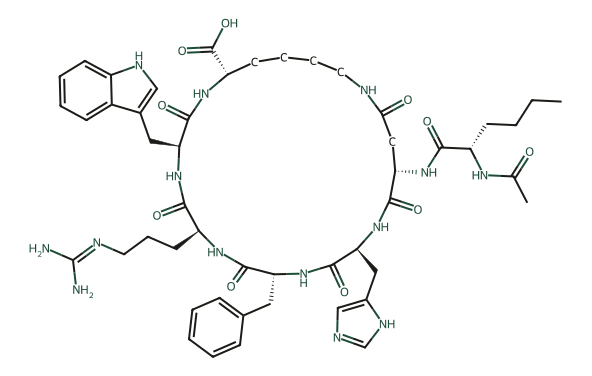
2D structure · PubChem record, redrawn
Amino-acid sequence
- * N-terminus acetylated
- * Position 1: Nle (norleucine)
- * Position 4: D-Phe
- * Cyclic: lactam bridge Asp2-Lys7
- * C-terminus free acid - the one-atom difference from Melanotan II
Sequence per PubChem CID 9941379 - X marks a non-standard residue, detailed above.
Dose ranges
Study-backed ranges carry a source you can open. Community ranges are widely reported but not clinically established - treat them as what people do, not as advice.
FDA-approved dose for acquired, generalized hypoactive sexual desire disorder (HSDD) in premenopausal women (Vyleesi)
study1.75 mg
Subcutaneous injection (abdomen or thigh) via prefilled autoinjector, at least 45 minutes before anticipated sexual activity; maximum 1 dose per 24 hours and no more than 8 doses per month
Community-reported research or off-label use (for example self-directed dosing in men, or lower-dose titration); not clinically established or FDA-evaluated
community0.5-2 mg
As needed, commonly reported as not more than once per 24 hours
Reconstitution & storage
These figures describe community and compounding-vendor practice for lyophilized research-grade PT-141 powder, not the FDA-approved product. Vyleesi, the approved drug, is dispensed as a prefilled, single-use autoinjector and is never reconstituted by the patient or pharmacist at the point of use. Outside that approved product, vendors selling PT-141 as a research or compounded item commonly describe 5 mg, 10 mg, or 20 mg lyophilized vials mixed with roughly 1 to 3 mL of bacteriostatic water to produce a range of working concentrations. These practices are not FDA-regulated, and the purity, sterility, and labeled content of such vials cannot be independently verified. [community]
Lyophilized
The FDA-approved autoinjector (Vyleesi) is not sold lyophilized; it ships as a ready-to-use liquid, single-dose, single-use autoinjector stored at or below 25 C (77 F), protected from light, and not frozen [study/DailyMed]. Community and vendor sources separately describe unreconstituted research-grade lyophilized PT-141 powder as stored frozen (about -20 C) for long-term keeping, or refrigerated (2-8 C) short-term before mixing; this is not part of any FDA-regulated labeling. [community]
Reconstituted
Not applicable to the FDA-approved product, which is never reconstituted by the patient. Community and vendor sources report that once research-grade PT-141 powder is mixed with bacteriostatic water, the resulting solution is kept refrigerated at about 2-8 C and used within roughly 28 to 30 days. These are vendor and community claims, not manufacturer specifications, and have not been independently verified. [community]
Ships as a white lyophilized powder cake in a 3 mL glass vial (5, 10, 20 mg sizes are typical), reconstituted with bacteriostatic water before use.
Run the numbers in the calculatorStacks and pairings
Interactions & cautions
Vyleesi's FDA label lists uncontrolled hypertension and known cardiovascular disease as contraindications because each dose causes a transient rise in blood pressure (maximal increases of about 6 mmHg systolic and 3 mmHg diastolic, peaking 2 to 4 hours post-dose) and a transient fall in heart rate (up to about 5 bpm), effects that typically resolve within about 12 hours. Bremelanotide also slows gastric emptying, which can reduce the rate and extent of absorption of concomitantly administered oral medications, including drugs that depend on reaching a threshold concentration such as antibiotics; the label specifically warns that it can significantly decrease systemic exposure to oral naltrexone, risking treatment failure in patients using naltrexone for alcohol or opioid use disorder, so combined use is discouraged. A pharmacokinetic study using intranasal bremelanotide (at a higher dose than the approved injectable) found no clinically significant pharmacokinetic interaction with alcohol, though flushing was slightly more frequent. The label does not directly address interaction with hormonal contraceptives despite its general caution about delayed absorption of oral drugs, so that specific question could not be verified. No formal drug-drug interaction data were located for community or research-grade reconstituted PT-141. [study/DailyMed, except where marked community]
Questions people ask
What is PT-141 (bremelanotide) FDA-approved for?
As Vyleesi, it is FDA-approved for acquired, generalized hypoactive sexual desire disorder (HSDD) in premenopausal women, dosed as a 1.75 mg subcutaneous injection taken on demand before anticipated sexual activity. It is not approved for postmenopausal women or for men, and it is not intended to enhance sexual performance.
How is PT-141 different from PDE5 inhibitors like sildenafil?
PDE5 inhibitors act on blood vessels to support genital blood flow. PT-141 instead activates melanocortin receptors, which are concentrated in the central nervous system; the FDA label notes that the precise mechanism by which it improves desire in HSDD is still unknown.
What are the most common side effects reported in trials?
In the FDA label and the RECONNECT trials, nausea was most common (around 40% of patients), followed by flushing, injection-site reactions, and headache. Vyleesi also causes a transient rise in blood pressure and fall in heart rate after each dose.
Is the compounded or research-grade PT-141 sold online the same as Vyleesi?
No. Vyleesi is a prefilled, single-use autoinjector that is never reconstituted by the patient. Lyophilized PT-141 powder sold by research or compounding vendors, which is mixed with bacteriostatic water before use, is a different, non-FDA-approved product whose purity, sterility, and dosing accuracy are not independently verified.
How long does PT-141 stay in the body?
The FDA label reports an elimination half-life of about 2.7 hours and a time to peak concentration of about 1 hour after subcutaneous injection.
Who should not use PT-141?
The FDA label lists uncontrolled hypertension and known cardiovascular disease as contraindications, because of the transient blood pressure and heart rate changes each dose causes. Repeated dosing can also cause focal hyperpigmentation that may not fully resolve after stopping.
Sources
- [1]VYLEESI (bremelanotide) injection - FDA-approved prescribing informationlabelFDA-approved indication (HSDD in premenopausal women), the 1.75 mg subcutaneous dose via single-use autoinjector with maximum 1 dose per 24 hours and 8 doses per month, contraindications (uncontrolled hypertension, known cardiovascular disease), the blood pressure/heart rate warning, focal hyperpigmentation and nausea rates, pharmacokinetics (half-life ~2.7 hours, Tmax ~1 hour, ~100% subcutaneous bioavailability), the naltrexone and delayed-gastric-emptying drug interactions, the mechanism of action (nonselective melanocortin receptor agonist, MC1R/MC4R), and storage/handling of the autoinjector.
- [2]Bremelanotide for the Treatment of Hypoactive Sexual Desire Disorder: Two Randomized Phase 3 Trials (RECONNECT) PMID 31599840studyDesign and topline results of the two identical RECONNECT phase 3 trials (1.75 mg subcutaneous bremelanotide vs. placebo in 1,267 premenopausal women with HSDD): statistically significant increases in sexual desire and reductions in desire-related distress versus placebo, with nausea, flushing, and headache (each >=10%) as the most common adverse events. Kingsberg SA et al., Obstet Gynecol 2019;134(5):899-908, doi 10.1097/aog.0000000000003500.
- [3]Long-Term Safety and Efficacy of Bremelanotide for Hypoactive Sexual Desire Disorder (RECONNECT open-label extension) PMID 31599847study52-week open-label extension of RECONNECT (684 of 856 eligible patients enrolled; 272 completed): treatment-emergent adverse events considered related to study drug were nausea (40.4%), flushing (20.6%), and headache (12.0%), with sustained improvement in sexual function measures and no new safety signals. Simon JA et al., Obstet Gynecol 2019;134(5):909-917, doi 10.1097/aog.0000000000003514.
- [4]Study to Evaluate the Efficacy and Safety of Bremelanotide in Premenopausal Women With HSDD (RECONNECT Study 301) - NCT02333071regulatoryRegistered phase 3 trial design and sponsor (Palatin Technologies), the 1.75 mg subcutaneous as-needed dosing regimen (max 1 dose/24h), enrollment (723 enrolled, 653 randomized into the double-blind phase), and primary outcome measures (FSFI desire domain, FSDS-DAO item 13) for RECONNECT study 301.
- [5]Study to Evaluate the Efficacy and Safety of Bremelanotide in Premenopausal Women With HSDD (RECONNECT Study 302) - NCT02338960regulatoryRegistered phase 3 trial design and enrollment (714 enrolled, 604 dosed in the core study) for the second identical RECONNECT trial, confirming the two-trial phase 3 program structure underlying the FDA approval.
- [6]Bremelanotide, CID 9941379 - PubChem Compound Summary (properties)referenceChemical identity of bremelanotide/PT-141: molecular formula C50H68N14O10, molecular weight ~1025.2 g/mol, and IUPAC name, confirming it as a cyclic heptapeptide.
- [7]Bremelanotide, CID 9941379 - PubChem Compound Summary (synonyms)referenceCAS registry number 189691-06-3 and UNII 6Y24O4F92S for bremelanotide, and confirmation that PT-141, PT 141, and Vyleesi are recognized synonyms for the same compound.
- [8]Bremelanotide - LiverTox: Clinical and Research Information on Drug-Induced Liver InjuryreferenceHepatotoxicity likelihood classification (category D: possible rare cause of clinically apparent liver injury), description of a single published case of acute hepatitis after repeated dosing, and the statement that no acute liver failure or chronic liver injury has been attributed to bremelanotide within limited clinical experience.
- [9]Bremelanotide for Treatment of Female Hypoactive Sexual Desire (narrative review) PMID 35076581reviewNarrative review confirming bremelanotide's melanocortin receptor agonist mechanism, the 1.75 mg on-demand subcutaneous dosing at least 45 minutes before sexual activity, and improvement in desire, arousal, and orgasm scores versus placebo. Edinoff AN et al., Neurol Int 2022;14(1):75-88, doi 10.3390/neurolint14010006.
- [10]PT-141 Dosing Calculator - Reconstitution & Units (Peptide Protocol Wiki)communityCommunity-reported vial sizes (5/10/20 mg), bacteriostatic-water reconstitution ratios and resulting concentrations, off-label dose ranges (0.5-2 mg), and post-reconstitution refrigerated storage/use-by practice for research-grade PT-141; the page itself distinguishes this from the FDA-approved Vyleesi autoinjector.
- [11]PT-141 (Bremelanotide) Dosage Guide: Reconstitution and Research Protocol (Know Your Peptide)communityCommunity-reported 10 mg and 5 mg vial reconstitution with bacteriostatic water and resulting concentrations, off-label research dose ranges (0.5-2 mg), and lyophilized-vs-reconstituted storage conditions and use-by windows.
What we could not verify
Full text of both primary RECONNECT publications (Kingsberg 2019 and Simon 2019, Obstet Gynecol) could not be opened directly: PMC blocked automated access with a reCAPTCHA challenge, and the publisher page on journals.lww.com returned HTTP 402 Payment Required. Structured abstract-level data from the Europe PMC REST API was used instead, which supports study design, sample sizes, primary-endpoint significance (p<0.001), and adverse-event percentages, but exact numeric mean-difference results for the FSFI desire domain and FSDS-DAO item 13 endpoints were not independently confirmed beyond that abstract-level detail. The FDA label's caution about delayed gastric emptying reducing oral drug absorption does not specifically name hormonal contraceptives, so a possible interaction with oral contraceptives could not be verified either way. The community-reported off-label dose range (0.5-2 mg, including any use in men) is not supported by any located clinical trial and should be read as anecdotal community practice, not an established range. Community-reported reconstituted-solution stability windows (2-8 C, use within about 28-30 days) come from peptide vendor/calculator sites, not from any pharmacopeial or regulatory stability study, and the purity/sterility of research-grade lyophilized PT-141 vials sold outside the approved product cannot be verified at all. The FDA label mentions a pharmacokinetic study of alcohol interaction using 'intranasal bremelanotide (higher dose than the injectable VYLEESI)', confirming an earlier intranasal formulation was studied, but its separate trial history and outcomes were not further investigated and are not claimed here beyond that one label mention.
Keep reading
Pepteca is for education and information only. It does not provide medical advice, diagnosis, or treatment, and its calculators perform unit math only. Always verify with a licensed provider before starting, changing, or stopping any protocol. Many peptides are not approved for human use and may be regulated differently where you live.