cat. no. MELANOTAN-II
Melanotan II: dosage, half-life and storage
Synthetic cyclic heptapeptide analog of alpha-melanocyte-stimulating hormone (alpha-MSH); non-selective melanocortin receptor agonist acting at MC1R, MC3R, MC4R and MC5R. Sold gray-market as an injectable subcutaneous research chemical for skin tanning and for erectile/libido effects; it is not FDA-approved or licensed by any medicines regulator for any indication. Its closest FDA-approved relative is bremelanotide (PT-141, brand name Vyleesi), a related but structurally distinct melanocortin agonist already covered separately in this library.
also: MT-II / MT2 / MT-2 / Melanotan 2 / Melanotan-II acetate / Tan jab
By An NayalLast reviewed 12 sources
At a glance
On this card (8)
What it is
Melanotan II (MT-II) is a synthetic cyclic peptide built from alpha-melanocyte-stimulating hormone (alpha-MSH). It activates several melanocortin receptors in the body rather than just one, which is why it produces two very different effects: it stimulates skin pigment cells to make more melanin (tanning), and, discovered somewhat by accident during early human testing, it also triggers spontaneous erections and increased sexual desire. A small 1996 phase-I study first showed dose-dependent tanning and documented nausea, fatigue, and unprompted erections as side effects. Later placebo-controlled studies specifically tested it as a treatment for erectile dysfunction, with meaningful erection and desire responses but frequent nausea. Despite this research history, melanotan II has never been approved by the FDA or any other medicines regulator for any use; it is sold online as an unregulated 'research chemical' or gray-market 'tan jab,' typically self-injected after reconstituting powder with bacteriostatic water. That unregulated status matters clinically: published case reports describe new or changing moles, dysplastic nevi, and melanoma appearing after melanotan II use, plus at least one case of severe rhabdomyolysis after a high-dose self-injection. Its FDA-approved chemical relative, bremelanotide (PT-141/Vyleesi), uses a related mechanism but is a distinct, regulated product with its own dosing and safety data.
The molecule
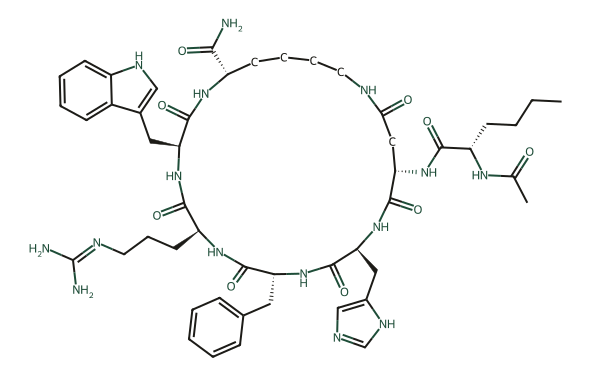
2D structure · PubChem record, redrawn
Amino-acid sequence
- * N-terminus acetylated
- * Position 1: Nle (norleucine)
- * Position 4: D-Phe
- * Cyclic: lactam bridge Asp2-Lys7
- * C-terminus amidated
Sequence per PubChem CID 92432 - X marks a non-standard residue, detailed above.
Dose ranges
Study-backed ranges carry a source you can open. Community ranges are widely reported but not clinically established - treat them as what people do, not as advice.
Phase I dose-escalation study in healthy male volunteers, evaluating tanning/pigmentation response (Dorr et al. 1996)
study0.01-0.03 mg/kg
Subcutaneous injection on alternating days for 2 consecutive weeks, with dose escalation between subjects; the authors recommended 0.025 mg/kg/day as the dose for further study
Investigational dosing used in double-blind, placebo-controlled crossover studies of erectile dysfunction (Wessells et al. 1998 and 2000)
study0.025 mg/kg
Single subcutaneous dose administered under research/clinic supervision, monitored for up to 6 hours by RigiScan
Community-reported self-directed use for tanning or libido, purchased as an unregulated research-chemical vial; not clinically established or evaluated by any regulator
community0.1-0.5 mg
Community protocols commonly describe a 'loading phase' of roughly 100 to 500 mcg per day (sometimes split into 2-3 injections) for 1 to a few weeks, then a lower-frequency maintenance phase; specific regimens vary widely across vendor and forum sources and are not standardized
Reconstitution & storage
Melanotan II is sold by research-chemical and peptide vendors as a lyophilized powder that must be reconstituted with bacteriostatic water before subcutaneous injection; no such product is FDA-approved or pharmacopeially standardized. Community and vendor sources commonly describe 5 mg or 10 mg vials mixed with about 1 to 3 mL of bacteriostatic water, with a 10 mg vial plus 2 mL water (yielding roughly 5 mg/mL, or 5,000 mcg/mL) cited most often. These figures are vendor and community practice, not manufacturer specifications, and the purity, sterility, and actual labeled content of such vials cannot be independently verified. [community]
Lyophilized
No FDA or other regulator-approved label exists for melanotan II, so there is no official storage specification. Vendor and community sources describe unreconstituted lyophilized powder as stable stored frozen or refrigerated (roughly 2-8 C) and protected from light before mixing; these are unverified vendor claims, not pharmacopeial data. [community]
Reconstituted
Community and vendor sources report that once mixed with bacteriostatic water, the solution should be kept refrigerated (about 2-8 C) and used within roughly 2 to 4 weeks (commonly cited as 28 days). These are vendor and community claims only; no stability study for reconstituted melanotan II was located. [community]
Ships as a white lyophilized powder cake in a 3 mL glass vial (5, 10 mg sizes are typical), reconstituted with bacteriostatic water before use.
Run the numbers in the calculatorStacks and pairings
Interactions & cautions
No formal drug-drug interaction studies for melanotan II were located in the peer-reviewed literature; because it is not an approved drug, no regulator-reviewed label or interaction data exists. As a non-selective melanocortin receptor agonist, its published human studies describe centrally mediated effects (spontaneous penile erection, increased sexual desire, nausea, yawning/stretching, facial flushing, fatigue) that are mechanistically related to those of its FDA-approved relative bremelanotide (PT-141/Vyleesi), but no controlled study has evaluated melanotan II's effect on blood pressure, heart rate, or interaction with other medications the way the Vyleesi label does for bremelanotide, so that cannot be extrapolated as established fact. Case reports describe systemic sympathomimetic toxicity (tachycardia, hypertension, mydriasis, tremor) and rhabdomyolysis after high-dose self-injection of unregulated product, which raises theoretical concern about combining melanotan II with stimulants or other sympathomimetic substances, though no formal interaction study confirms this. [study, except where marked community]
Questions people ask
Is Melanotan II FDA-approved?
No. Melanotan II has never been approved by the FDA or any other national medicines regulator for tanning, sexual dysfunction, or any other use. It is sold online as an unregulated research chemical; it is illegal to sell or supply in the UK, and regulators in the US, UK, and other countries have warned against its unlicensed sale.
How is Melanotan II different from PT-141 (bremelanotide)?
Both are synthetic melanocortin-receptor-based peptides derived from the alpha-MSH family, but they are chemically distinct molecules. Bremelanotide (PT-141) was refined from earlier melanotan research specifically for sexual dysfunction and is FDA-approved as Vyleesi with its own dosing, safety, and interaction data. Melanotan II itself remains unapproved and is not the same product.
Can Melanotan II cause changes in moles or skin cancer risk?
Published case reports describe darkening of existing moles, sudden eruption of new nevi, transformation of nevi into dysplastic (atypical) nevi, and melanoma occurring after melanotan II use, particularly in people with fair skin, many moles, or tanning-bed use. Anyone using it should have new or changing moles evaluated by a dermatologist promptly.
What side effects were reported in clinical studies?
Early human studies reported nausea, facial flushing, fatigue, yawning/stretching, decreased appetite, and spontaneous penile erections (sometimes prolonged) as the most common effects. A case report also documents rhabdomyolysis and systemic sympathomimetic toxicity after a high-dose self-injection of unregulated product.
How long does Melanotan II stay in the body?
No peer-reviewed human pharmacokinetic study specific to melanotan II's half-life was located. Community and vendor sources commonly cite a half-life of roughly 1 hour, but this figure has not been independently verified in the published literature and should be treated as unconfirmed.
Sources
- [1]Evaluation of melanotan-II, a superpotent cyclic melanotropic peptide in a pilot phase-I clinical study PMID 8637402studyDesign and results of the first human phase-I trial of MT-II: subcutaneous dose escalation from 0.01 to 0.03 mg/kg on alternating days over 2 weeks, dose-dependent skin pigmentation, spontaneous penile erections correlated with a yawning/stretching complex, and side effects of mild nausea and fatigue; recommended 0.025 mg/kg/day for further study. Dorr RT et al., Life Sciences 1996;58(20):1777-1784, doi 10.1016/0024-3205(96)00160-9.
- [2]Synthetic melanotropic peptide initiates erections in men with psychogenic erectile dysfunction: double-blind, placebo controlled crossover study PMID 9679884studyDouble-blind, placebo-controlled crossover trial (10 men) at 0.025 mg/kg subcutaneous MT-II: 8 of 10 men achieved clinically apparent erections (mean RigiScan tip rigidity >80% duration 38.0 min vs. 3.0 min placebo, p=0.0045), with nausea, stretching, yawning, and decreased appetite as more frequent side effects than placebo. Wessells H et al., J Urol 1998;160(2):389-393, doi 10.1016/s0022-5347(01)62903-3.
- [3]Melanocortin receptor agonists, penile erection, and sexual motivation: human studies with Melanotan II PMID 11035391studyReview of the authors' clinical experience with MT-II (0.025 mg/kg subcutaneous) in 20 men with psychogenic and organic erectile dysfunction: erection in 17 of 20 men without sexual stimulation, mean 41 min RigiScan tip rigidity >80%, increased sexual desire after 68% of MT-II doses vs. 19% of placebo doses (P<0.01), and nausea/yawning as the most frequent side effects (severe nausea in 12.9% of subjects at 0.025 mg/kg). Wessells H et al., Int J Impot Res 2000;12(Suppl 4):S74-S79, doi 10.1038/sj.ijir.3900582.
- [4]Melanotan II injection resulting in systemic toxicity and rhabdomyolysis PMID 23121206studyCase report: a 39-year-old man self-injected 6 mg of unregulated melanotan II (about six times a typical starting dose) and developed tachycardia, hypertension, mydriasis, and tremor, with CPK rising from 1,760 to a peak of 17,773 IU/L (rhabdomyolysis) and myoglobinuria; he improved over 3 ICU days with IV fluids, sodium bicarbonate, and benzodiazepines; product identity was confirmed as melanotan II by mass spectrometry. Nelson ME, Bryant SM, Aks SE, Clin Toxicol (Phila) 2012;50(10):1169-1173, doi 10.3109/15563650.2012.740637.
- [5]Melanoma associated with the use of melanotan-II PMID 24355990studyCase report of a 20-year-old woman (Fitzpatrick skin type II) diagnosed with melanoma on the gluteal region 3 months after a 3-4 week self-injection course of melanotan II undertaken to augment sunbed tanning; authors caution that melanotan II is unlicensed and incompletely tested, with unknown adverse-effect potential, and recommend counseling at-risk patients. Hjuler KF, Lorentzen HF, Dermatology 2014;228(1):34-36, doi 10.1159/000356389.
- [6]Eruptive dysplastic nevi following melanotan use PMID 22425244studyCase report of a 25-year-old man (skin phototype II, regular tanning-bed user) who developed a sudden eruption of over 100 melanocytic nevi on his back plus transformation of existing lesions after 4 weeks of subcutaneous melanotan II; histopathology of the 10 most atypical lesions showed dysplastic nevi with severe dysplasia in 3, plus an incidental pigmented basal cell carcinoma; authors advise clinicians to suspect melanotan use when seeing sudden nevus eruption/transformation with disproportionate tanning. Hueso-Gabriel L et al., Actas Dermosifiliogr 2012;103(4):329-331, doi 10.1016/j.ad.2011.10.001.
- [7]Change in moles linked to use of unlicensed 'sun tan jab' PMID 19174439studyEarly published report (BMJ) documenting transformation of pre-existing melanocytic nevi in patients following use of unlicensed melanotan injections, indexed under pigmented nevus pathology and adverse effects of melanotan-II; full abstract text was not retrievable, so only the report's existence, title, and indexed subject matter are cited here. Langan EA et al., BMJ 2009;338:b277, doi 10.1136/bmj.b277.
- [8]Melanotan II - DermNet NZreferenceClinical dermatology reference summary: mechanism (non-selective melanocortin peptide mimetic stimulating eumelanin production), unlicensed/untested regulatory status, subcutaneous every-other-day administration pattern, short-term adverse effects (facial flushing, nausea/vomiting, appetite suppression, priapism/spontaneous erections), and long-term concerns (melanoma risk, darkening/new/atypical moles, melanonychia, rhabdomyolysis, encephalopathy, contamination risk from unregulated vials).
- [9]Tanning, fake tan and MelanotanreferencePublic-health charity summary confirming melanotan II is an artificial melanin-stimulating substance sold as injections/nasal sprays, that it is illegal to sell or supply melanotan injections in the UK, that products are unlicensed and have not been tested for safety, quality, or effectiveness, and may contain undisclosed harmful chemicals.
- [10]melanotan-II, CID 92432 - PubChem Compound Summary (properties)referenceChemical identity of melanotan II: molecular formula C50H69N15O9, molecular weight 1024.2 g/mol, IUPAC name and canonical SMILES, confirming it as a cyclic (lactam-bridged) heptapeptide.
- [11]Melanotan-2 Reconstitution: 10mg + 2mL Chart (The Peptide Catalog)communityCommunity-reported reconstitution practice: 10 mg vial plus 2 mL bacteriostatic water yields about 5,000 mcg/mL; a 250 mcg dose equals 0.05 mL (5 units on a U-100 insulin syringe); reconstituted solution should be refrigerated (2-8 C) and used within about 28 days.
- [12]Melanotan II Dosage, Half-Life & Protocol Guide (Milligram)communityCommunity-reported half-life estimate of approximately 1 hour following subcutaneous injection; community dosing protocols (100-500 mcg/day, 2-3 times weekly, over 8-16 weeks); nausea as the most frequently reported side effect, typically appearing within minutes and lasting 1-2 hours; reconstituted-solution refrigerated storage and 2-4 week use window.
What we could not verify
No FDA, EMA, or MHRA-approved label exists for melanotan II because it is not an approved drug anywhere; all storage, reconstitution, and self-dosing figures in this entry come from unregulated vendor and community sources and could not be independently verified for accuracy, purity, or sterility. No peer-reviewed human pharmacokinetic (half-life) study specific to melanotan II was located; the ~1 hour figure given here is a community estimate only, and other unverified community sources cite conflicting, much longer figures, so this value should be treated as low-confidence. Full text of several relevant sources could not be opened despite resolving at the bibliographic/abstract level: PMC full-text pages for a 2024 melanocortin-1-receptor risk/benefit review and for a melanotan II renal-infarction case report both returned an automated reCAPTCHA challenge rather than article content; ScienceDirect Topics' melanotan-II overview page returned HTTP 403; the UK Parliament written-answer record citing specific MHRA adverse-reaction-report counts for melanotan returned HTTP 403; a 2013 trade-press article on the MHRA's melanotan warning returned HTTP 410 Gone; PubMed abstract pages for the Dorr, Wessells, and rhabdomyolysis studies were blocked by a cookie-consent wall (Europe PMC's REST API was used instead and did resolve for all of these, providing the abstract text actually cited here). For the Langan et al. 2009 BMJ report, only bibliographic metadata and MeSH indexing terms could be retrieved, not the full abstract text, so specific patient details for that report (for example patient ages) are not asserted here. Because melanotan II is sold as an unregulated research chemical, no formal drug interaction studies exist, and product identity, potency, and contamination status of any given vial cannot be verified from the literature at all; the interaction_warning above is drawn from published case reports, which by nature cannot establish incidence or causal frequency, only that the association has been reported.
Keep reading
Pepteca is for education and information only. It does not provide medical advice, diagnosis, or treatment, and its calculators perform unit math only. Always verify with a licensed provider before starting, changing, or stopping any protocol. Many peptides are not approved for human use and may be regulated differently where you live.