cat. no. MK-677
MK-677: dosage, half-life and storage
Oral, non-peptide ghrelin receptor (growth hormone secretagogue receptor / GHSR1a) agonist and growth hormone secretagogue; investigational only, not approved by the FDA or any major regulator.
also: Ibutamoren / MK-0677 / Ibutamoren Mesylate / L-163,191 / LUM-201
By An NayalLast reviewed 12 sources
At a glance
On this card (8)
What it is
MK-677 (ibutamoren, also known as MK-0677) is an orally active, non-peptide small molecule that binds the ghrelin receptor (GHSR1a) and works as a growth hormone secretagogue: it stimulates the pituitary to release growth hormone in a pulsatile pattern and raises IGF-1. Unlike injectable growth hormone releasing peptides, it is taken by mouth. Merck developed it and tested it in randomized, placebo-controlled human trials for several conditions, none of which led to approval. In healthy older adults, 25 mg per day for up to two years increased fat-free mass but did not improve strength or physical function, and it raised fasting blood glucose while reducing insulin sensitivity. A 563-person, 12-month trial in mild-to-moderate Alzheimer's disease found no cognitive benefit despite a large rise in IGF-1. A hip-fracture recovery trial was stopped early after a congestive heart failure signal appeared in the treatment group. MK-677 is not approved by the FDA or any major regulator for any use, and in 2024 an FDA advisory committee voted against allowing pharmacies to use it in compounding. Development continues under the name LUM-201 for pediatric growth hormone deficiency. Outside of trials, it is sold online as an unregulated research chemical.
The molecule
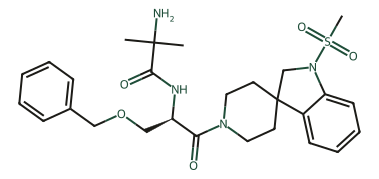
2D structure · PubChem record, redrawn
Dose ranges
Study-backed ranges carry a source you can open. Community ranges are widely reported but not clinically established - treat them as what people do, not as advice.
Dose-finding trial, healthy older adults (GH/IGF-1 stimulation)
study2 to 25 mg
once daily, oral, for up to 28 days
Reversal of diet-induced (caloric restriction) catabolism, healthy adults
study25 mg
once daily, oral, for 7 days
Body composition, healthy older adults (pivotal long-term trial)
study25 mg
once daily, oral, for up to 2 years
Mild-to-moderate Alzheimer's disease (no cognitive benefit found)
study25 mg
once daily, oral, for 12 months
Post-hip-fracture functional recovery (trial stopped early for a cardiac safety signal)
study25 mg
once daily, oral; trial terminated early
Self-directed/anecdotal use reported online (not clinically supervised)
community10 to 25 mg
once daily, oral
Storage
Lyophilized
MK-677 is not supplied as a lyophilized injectable. In studies and as sold, it is a capsule, tablet, or powder/solution taken by mouth.
Reconstituted
Not applicable in the injectable sense; MK-677 is not reconstituted from a lyophilized vial. We could not find clinically or manufacturer-sourced storage/stability data (temperature, light, moisture protection) specific to oral MK-677/ibutamoren mesylate. The one government label we located (DailyMed, bulk ibutamoren mesylate powder for animal drug compounding) includes no storage section.
An oral secretagogue - sold as capsules or a flavored solution, not a vial.
Run the numbers in the calculatorStacks and pairings
Interactions & cautions
MK-677 has never been approved, so no formal human drug-drug interaction trials have been published. The clearest signal from the available placebo-controlled trials is metabolic: in the dose-finding study (Chapman et al., 1996), fasting glucose rose from 5.4 to 6.8 mmol/L after 4 weeks of 25 mg/day; in the 2-year trial (Nass et al., 2008), fasting glucose rose by about 0.3 mmol/L (5 mg/dL) on average and insulin sensitivity decreased. This is relevant to people with diabetes, prediabetes, or other insulin-resistance risk, and to anyone taking glucose-lowering medication, since MK-677's effect on glucose could work against it, though no formal interaction study with a specific diabetes drug has been done. Fluid retention/edema and appetite increase were also common in the same trials. Separately, a randomized hip-fracture-recovery trial (Adunsky et al., 2011) was stopped early after a safety signal of congestive heart failure appeared in a limited number of MK-677 recipients, in a frail elderly population; whether this generalizes to healthier or younger users has not been studied. In 2024, an FDA advisory committee (the Pharmacy Compounding Advisory Committee) voted against adding ibutamoren mesylate to the list of bulk substances compounding pharmacies may use, so it remains outside routine, regulated clinical and pharmacy channels.
Questions people ask
Is MK-677 (ibutamoren) approved by the FDA?
No. MK-677 has never been approved by the FDA or any major medicines regulator for any indication. It remains investigational; in 2024 an FDA advisory committee (the Pharmacy Compounding Advisory Committee) voted against allowing it on the list of substances compounding pharmacies may use.
How does MK-677 differ from injectable growth hormone releasing peptides?
MK-677 is a non-peptide small molecule that survives digestion, so it is taken as an oral capsule, tablet, or powder rather than injected. It acts on the same ghrelin receptor (GHSR1a) pathway as peptides like ipamorelin or GHRP-6, stimulating pulsatile growth hormone release and raising IGF-1.
What did the largest long-term human study find?
Nass and colleagues (2008) gave 25 mg/day oral MK-677 or placebo to 65 healthy adults aged 60 to 81 for up to 2 years. Fat-free mass increased significantly versus placebo, but strength and physical function were not improved, and the treatment group had higher fasting glucose, lower insulin sensitivity, and more appetite increase, mild leg edema, and muscle pain.
Was MK-677 ever tested for Alzheimer's disease?
Yes. A 563-patient, 12-month randomized trial (Sevigny et al., 2008) tested 25 mg/day oral MK-677 in mild-to-moderate Alzheimer's disease. It raised IGF-1 by roughly 60 to 73 percent but produced no benefit on any cognitive or functional measure, and the drug was not pursued for this use.
What is MK-677's half-life?
A 2020 peer-reviewed review reports an oral elimination half-life of about 5 to 6 hours. Some non-clinical sources describe a much longer figure of around 24 hours, but that appears to describe how long a single dose keeps IGF-1 elevated, not how quickly the drug itself is cleared; we could not trace that 24-hour figure to a verifiable primary pharmacokinetic study.
What are the main safety concerns reported in trials?
The most consistent findings across trials are increased appetite, fluid retention/mild edema, and a rise in fasting glucose with reduced insulin sensitivity. A separate trial in frail elderly hip-fracture patients was stopped early after a congestive heart failure signal appeared in the MK-677 group.
Sources
- [1]Stimulation of the growth hormone (GH)-insulin-like growth factor I axis by daily oral administration of a GH secretogogue (MK-677) in healthy elderly subjects PMID 8954023studyDose-ranging trial (2, 10, or 25 mg/day oral MK-677) in healthy elderly subjects showing a dose-dependent rise in 24-hour GH and IGF-1, and a significant increase in fasting glucose (5.4 to 6.8 mmol/L) after 4 weeks at 25 mg/day.
- [2]MK-677, an orally active growth hormone secretagogue, reverses diet-induced catabolism PMID 9467534study25 mg/day oral MK-677 during a 7-day caloric-restriction period reversed diet-induced negative nitrogen balance in healthy adults and was reported as generally well tolerated short-term.
- [3]Effects of an oral ghrelin mimetic on body composition and clinical outcomes in healthy older adults: a randomized trial PMID 18981485study2-year, randomized, placebo-controlled, modified-crossover trial of 25 mg/day oral MK-677 in 65 adults aged 60-81: increased fat-free mass (P<0.001), raised fasting glucose and lowered insulin sensitivity, raised cortisol, and the most frequent side effects were appetite increase, transient mild leg edema, and muscle pain, with no serious adverse effects and no improvement in strength or function.
- [4]Growth hormone secretagogue MK-677: no clinical effect on AD progression in a randomized trial PMID 19015485study563-patient, 12-month randomized trial of 25 mg/day oral MK-677 in mild-to-moderate Alzheimer's disease: IGF-1 rose 60.1% at 6 weeks and 72.9% at 12 months, but there was no significant benefit on cognitive or functional outcomes (CIBIC-plus, ADAS-Cog, ADCS-ADL, CDR-sob).
- [5]MK-0677 (ibutamoren mesylate) for the treatment of patients recovering from hip fracture: a multicenter, randomized, placebo-controlled phase IIb study PMID 21067829studyPhase IIb trial of 25 mg/day MK-0677 in 123 elderly hip-fracture patients: IGF-1 rose significantly (P<0.001) and gait speed improved, but the trial was terminated early after a safety signal of congestive heart failure in a limited number of patients, and the authors concluded MK-0677 has an unfavorable safety profile in this population.
- [6]Beyond the androgen receptor: the role of growth hormone secretagogues in the modern management of body composition in hypogonadal males PMID 32257855reviewPeer-reviewed review reporting an oral elimination half-life of 5 to 6 hours for ibutamoren, summarizing trial doses (2/10/25 mg and 25 mg regimens), and noting elevated prolactin, fasting glucose, insulin, and fluid retention as reported adverse effects.
- [7]NCATS Inxight Drugs: IbutamorenreferenceNIH drug-development database confirming ibutamoren is investigational only (never approved), reached Phase 2, and was developed by Merck for indications including fibromyalgia, muscle wasting in chronic kidney disease, Alzheimer's disease, and hip fracture, with development discontinued; provides CAS number and molecular formula.
- [8]PubChem Compound Summary for CID 178024, IbutamorenreferenceChemical identity: IUPAC name, molecular formula C27H36N4O5S, molecular weight 528.7, and (via the linked synonyms record) CAS number 159634-47-6 and synonyms including MK-677, MK-0677 forms, and L-163,191.
- [9]DailyMed: AX PHARMACEUTICAL CORP - ibutamoren mesylate powderregulatoryConfirms the only DailyMed listing found for ibutamoren mesylate is a bulk ingredient for animal drug compounding (not an FDA-approved human drug product), 99 g/100 g white powder, and the label includes no storage instructions.
- [10]PCAC votes against four nominated bulk drug substancesreferenceTrade-press report confirming the FDA's Pharmacy Compounding Advisory Committee voted against adding ibutamoren mesylate (along with three other substances) to the Section 503A bulk drug substances list for human compounding.
- [11]ClinicalTrials.gov: A Phase 3 Study of LUM-201 in Children With Growth Hormone Deficiency (NCT06948214)regulatoryRegistry record confirming an active, recruiting Phase 3 trial of oral LUM-201 (the current development code for ibutamoren) for treatment-naive pediatric growth hormone deficiency, sponsored by Lumos Pharma; confirms the compound remains unapproved and in development for this indication.
- [12]MK 677: Your Ultimate Ibutamoren ResourcecommunityCommunity/health-content source reporting a typical self-directed dosing range of 10 to 25 mg/day, noting MK-677 is not FDA-approved, and describing water retention and insulin-sensitivity concerns anecdotally.
What we could not verify
Could not verify a specific human single- or multiple-dose pharmacokinetic study directly reporting oral bioavailability percentage or Cmax/Tmax for MK-677. The frequently repeated figures of 60 to 70 percent oral bioavailability and a roughly 24-hour half-life appear only on vendor and nootropics-aggregator sites (community grade, not cited in this record) and could not be traced to an openly accessible primary pharmacokinetic paper; one such aggregator (bodynutrition.org) was checked and found to make an unsupported claim that MK-677 is 'under 2026 clinical standards... deployed strictly for severe muscle wasting,' which is false (it is not approved for any use), so that site was excluded entirely as unreliable. The single peer-reviewed source we could open and read in full that gives a half-life value (Sinha et al. 2020, Transl Androl Urol) reports 5 to 6 hours, which is the value used in this record; we could not independently open that review's own underlying primary source for the figure. No compound-specific, sourced storage or stability data (temperature, light, moisture protection) was found: the DailyMed bulk-ingredient label for ibutamoren mesylate includes no storage section, and no USP monograph for ibutamoren exists (doi.usp.org returned no result for the search). We could not confirm the FDA's own stated rationale for its 2024 Pharmacy Compounding Advisory Committee vote against ibutamoren mesylate (for example, whether the cardiac or metabolic signal was explicitly cited): fda.gov briefing- and meeting-document URLs returned 403 Forbidden on direct fetch every time they were tried, so the vote itself is sourced only to a secondary trade-press report (a4pc.org), not to the FDA's own document; the exact meeting date (probably around October 29, 2024, based on secondary references) is likewise not independently confirmed from a source we opened. The specific patient counts sometimes quoted for the congestive-heart-failure signal in the Adunsky et al. 2011 hip-fracture trial (for example, a '4 of 62 versus 1 of 61' breakdown appearing in secondary summaries) could not be confirmed from the abstract text we were able to read, which states only that the trial 'was terminated early due to a safety signal of congestive heart failure in a limited number of patients'; we deliberately did not include the specific counts in this record because we could not verify them ourselves. The '10 to 25 mg/day' community/self-directed dosing figure could only be traced to health-content aggregator pages rather than an actual forum or patient discussion thread, so it should be treated as directionally consistent with clinical dosing rather than independently verified anecdotal reporting. No oral bioavailability percentage is included anywhere in this record because it could not be verified. Everything else in this record is sourced to the citations list; nothing here was invented. The October 2024 timing of the FDA Pharmacy Compounding Advisory Committee vote against adding ibutamoren to the 503A bulk-compounding list is independently corroborated by FDA meeting records and the Federal Register; the trade-press source cited here confirms the vote but does not itself state the year.
Keep reading
Pepteca is for education and information only. It does not provide medical advice, diagnosis, or treatment, and its calculators perform unit math only. Always verify with a licensed provider before starting, changing, or stopping any protocol. Many peptides are not approved for human use and may be regulated differently where you live.