cat. no. CAGRILINTIDE
Cagrilintide: dosage, half-life and storage
Long-acting, acylated amylin analog (dual amylin/calcitonin receptor agonist) that is investigational only (not FDA-approved) and is most often developed and dosed together with the GLP-1 receptor agonist semaglutide as the once-weekly subcutaneous combination CagriSema.
also: AM833 / NNC0174-0833
By An NayalLast reviewed 19 sources
At a glance
On this card (8)
What it is
Cagrilintide (development code AM833) is a long-acting amylin analog, not a GLP-1 medicine, though it is almost always discussed alongside one. Amylin is a natural pancreatic hormone that works alongside insulin to slow gastric emptying and promote satiety. Cagrilintide is a modified, fatty-acid-linked version of that hormone, engineered the same way semaglutide was, so it can be dosed once weekly by subcutaneous injection instead of the multiple daily injections required by the older amylin drug pramlintide. Cagrilintide has been studied alone (phase 2, doses 0.3-4.5 mg weekly) and, more prominently, combined with semaglutide 2.4 mg as the fixed-dose product CagriSema, across a phase 1b trial, a phase 2 trial in type 2 diabetes, and the large phase 3 REDEFINE program. In these trials, cagrilintide plus semaglutide produced substantially more weight loss than semaglutide alone, with gastrointestinal side effects as the main tolerability issue. As of August 2026, neither cagrilintide nor CagriSema is approved by the FDA or any other regulatory agency; Novo Nordisk filed a New Drug Application for CagriSema in December 2025, with an FDA decision expected later in 2026. Because it remains investigational, there is no manufacturer label, and any reconstitution, storage, or dosing information found outside clinical trials is community-reported only, never clinically established.
The molecule
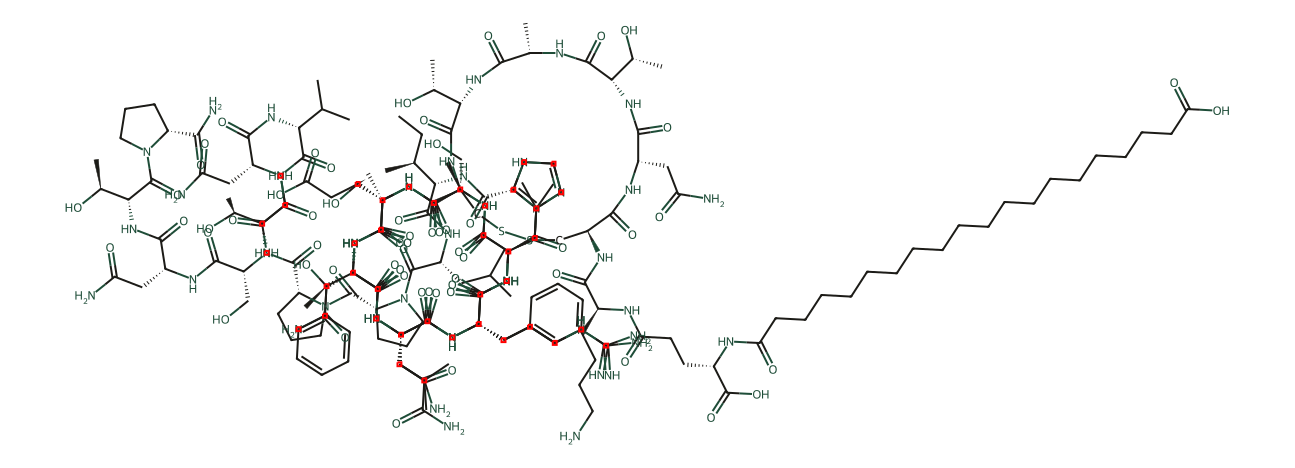
2D structure · PubChem record, redrawn
Amino-acid sequence
- * Lys1 alpha-amino acylated with gamma-Glu linked to a C20 fatty diacid
- * Disulfide bridge Cys2-Cys7
- * C-terminus amidated (Pro37-NH2)
Sequence per PubChem CID 171397054.
Dose ranges
Study-backed ranges carry a source you can open. Community ranges are widely reported but not clinically established - treat them as what people do, not as advice.
Monotherapy, dose-finding phase 2 trial, adults with overweight or obesity
study0.3-4.5 mg
once weekly, subcutaneous, dose-escalated over a 26-week trial
Combined with semaglutide 2.4 mg, phase 1b trial, adults with overweight or obesity
study0.16-4.5 mg
once weekly, subcutaneous, co-escalated with semaglutide over a 16-week period
CagriSema fixed-dose combination with semaglutide 2.4 mg, phase 2 (type 2 diabetes) and phase 3 REDEFINE program (obesity/overweight and type 2 diabetes)
study2.4 (co-administered with semaglutide 2.4 mg) mg
once weekly, subcutaneous
Self-reported research/community titration schedule (not clinical guidance)
community0.25-2.4 mg
once weekly, subcutaneous, titrated upward over roughly 12-16 weeks
Reconstitution & storage
No FDA-approved product or manufacturer reconstitution instructions exist for cagrilintide, since it is not an approved drug. The figures here are community-reported conventions from peptide-vendor and dosing-calculator sites, not clinical or manufacturer specifications: commonly listed research-use vial sizes of 3, 5, or 10 mg are reconstituted with 1-2 mL bacteriostatic water (for example, a 5 mg vial with 1 mL yields about 5 mg/mL, or with 2 mL yields about 2.5 mg/mL). Vial sizes and volumes vary by supplier and could not be independently verified.
Lyophilized
No manufacturer storage specification exists because cagrilintide is not an approved product. Community/vendor sources commonly report keeping unreconstituted lyophilized powder refrigerated (2-8C) for up to about 2 years, but this could not be independently verified against any official source.
Reconstituted
Community sources commonly report keeping reconstituted solution refrigerated (2-8C) and using it within about 4 weeks, but this is not confirmed by any manufacturer label since none exists for cagrilintide.
Ships as a white lyophilized powder cake in a 3 mL glass vial (3, 5, 10 mg sizes are typical), reconstituted with bacteriostatic water before use.
Run the numbers in the calculatorStacks and pairings
Interactions & cautions
Cagrilintide has no FDA-approved label, so there is no official drug-interaction section for it. Across the published trials (phase 1b Enebo et al 2021, phase 2 Lau et al 2021 monotherapy and Frias et al 2023 CagriSema, and phase 3 REDEFINE 1 Garvey et al 2025 and REDEFINE 2 Davies et al 2025), the dominant tolerability issue was gastrointestinal: nausea, vomiting, decreased appetite, early satiety, and dyspepsia, generally mild to moderate and similar in character to GLP-1 receptor agonists. A dedicated thorough-QT study found cagrilintide 4.5 mg was not associated with clinically relevant QTc prolongation (Gabe et al 2024). Dedicated pharmacokinetic studies found renal or hepatic impairment did not meaningfully change cagrilintide exposure (Nielsen et al 2026). The most important interaction signal concerns hypoglycemia: in the phase 3 REDEFINE 2 trial in people with type 2 diabetes, the two severe hypoglycemia events reported both occurred in participants who were also taking a sulfonylurea. This fits the general mechanism of amylin analogs: by slowing gastric emptying and suppressing glucagon, they can unmask or worsen hypoglycemia from insulin or insulin secretagogues, which is why the related, FDA-approved amylin analog pramlintide (Symlin) carries a boxed warning for severe hypoglycemia when combined with insulin. Because cagrilintide is investigational and, in practice, often sourced outside regulated pharmacy channels, product purity, actual labeled content, and sterility are additional unverified risks that clinical-trial material does not carry.
Questions people ask
Is cagrilintide the same as semaglutide or another GLP-1 drug?
No. Cagrilintide is a long-acting amylin analog that works through amylin and calcitonin receptors, a different mechanism from GLP-1 receptor agonists like semaglutide. The two are frequently studied and dosed together as the combination CagriSema (cagrilintide 2.4 mg plus semaglutide 2.4 mg once weekly), which is why they are often mentioned together, but cagrilintide itself is not a GLP-1 medicine.
Is cagrilintide FDA-approved?
No. As of August 2026, cagrilintide is investigational and has no FDA-approved label, either alone or as CagriSema. Novo Nordisk submitted a New Drug Application for CagriSema in December 2025, and an FDA decision is expected later in 2026.
What is CagriSema?
CagriSema is Novo Nordisk's fixed-dose, once-weekly combination of cagrilintide 2.4 mg and semaglutide 2.4 mg, studied in the phase 3 REDEFINE program in people with obesity or overweight without diabetes (REDEFINE 1) and in people with type 2 diabetes (REDEFINE 2).
How long does cagrilintide stay in the body?
In the phase 1b trial, cagrilintide's elimination half-life ranged from about 159 to 195 hours (roughly 7 to 8 days) across the doses tested, consistent with once-weekly dosing.
Does cagrilintide interact with insulin or other diabetes medications?
This has not been extensively studied in cagrilintide specifically, but there is a real, sourced signal: in the phase 3 REDEFINE 2 trial, both severe hypoglycemia events reported occurred in participants who were also taking a sulfonylurea. The related, approved amylin analog pramlintide carries a boxed warning for severe hypoglycemia with insulin. See the interaction warning above.
What is cagrilintide chemically?
It is a peptide analog of human amylin modified with a fatty diacid attachment that promotes albumin binding and extends its duration of action, the same general strategy used to extend semaglutide's half-life. Its molecular formula is C194H312N54O59S2, with a molecular weight of about 4409 Da.
Sources
- [1]Enebo LB, Berthelsen KK, Kankam M, et al. Safety, tolerability, pharmacokinetics, and pharmacodynamics of concomitant administration of multiple doses of cagrilintide with semaglutide 2.4 mg for weight management: a randomised, controlled, phase 1b trial. Lancet. 2021;397(10286):1736-1748. PMID 33894838studyCagrilintide's mechanism (amylin/calcitonin receptor agonist), elimination half-life of 159-195 hours (about 7-8 days), doses 0.16-4.5 mg once weekly co-administered with semaglutide 2.4 mg, and weight-loss results at week 20 (up to 17.1% with cagrilintide 2.4 mg plus semaglutide).
- [2]Lau DCW, Erichsen L, Francisco AM, et al. Once-weekly cagrilintide for weight management in people with overweight and obesity: a multicentre, randomised, double-blind, placebo-controlled and active-controlled, dose-finding phase 2 trial. Lancet. 2021;398(10317):2160-2172. PMID 34798060studyCagrilintide monotherapy dose range 0.3-4.5 mg once weekly and weight reductions of 6.0%-10.8% versus 3.0% with placebo at 26 weeks.
- [3]Frias JP, Deenadayalan S, Erichsen L, et al. Efficacy and safety of co-administered once-weekly cagrilintide 2.4 mg with once-weekly semaglutide 2.4 mg in type 2 diabetes: a multicentre, randomised, double-blind, active-controlled, phase 2 trial. Lancet. 2023;402(10403):720-730. PMID 37364590studyCagriSema (cagrilintide 2.4 mg plus semaglutide 2.4 mg) in type 2 diabetes produced a mean bodyweight change of -15.6% at week 32.
- [4]Garvey WT, Bluher M, Osorto Contreras CK, et al; REDEFINE 1 Study Group. Coadministered Cagrilintide and Semaglutide in Adults with Overweight or Obesity. N Engl J Med. 2025;393(7):635-647. PMID 40544433studyREDEFINE 1 phase 3 trial (n=3417): CagriSema 2.4 mg/2.4 mg produced -20.4% mean body weight change versus -3.0% placebo at 68 weeks (treatment-policy estimand); gastrointestinal adverse events in 79.6% of the CagriSema group versus 39.9% placebo.
- [5]Davies MJ, Bajaj HS, Broholm C, et al; REDEFINE 2 Study Group. Cagrilintide-Semaglutide in Adults with Overweight or Obesity and Type 2 Diabetes. N Engl J Med. 2025;393(7):648-659. PMID 40544432studyREDEFINE 2 phase 3 trial in type 2 diabetes (n=1206): CagriSema produced -13.7% mean body weight change versus -3.4% placebo at 68 weeks; 73.5% reached HbA1c 6.5% or lower versus 15.9% placebo; gastrointestinal adverse events in 72.5% versus 34.4% placebo.
- [6]Gabe MBN, Fuhr R, Sinn A, et al. Cagrilintide is not associated with clinically relevant QTc prolongation: A thorough QT study in healthy participants. Diabetes Obes Metab. 2024;26(12):5805-5811. PMID 39279639studyCagrilintide 4.5 mg once weekly was not associated with clinically relevant QTcF prolongation versus placebo in 105 healthy participants.
- [7]Nielsen MJF, Becker NP, Duus HHH, et al. Renal or Hepatic Impairment Does Not Affect Pharmacokinetics, Safety, or Tolerability of Subcutaneous Cagrilintide. Clin Pharmacokinet. 2026;65(7):1087-1099. PMID 42228334studySingle subcutaneous doses of cagrilintide 0.6-0.9 mg produced comparable exposure across normal, mild, moderate, and severe renal or hepatic impairment groups, with no serious adverse events.
- [8]Kruse T, Hansen JL, Dahl K, et al. Development of Cagrilintide, a Long-Acting Amylin Analogue. J Med Chem. 2021;64(15):11183-11194. PMID 34288673studyMedicinal chemistry rationale: cagrilintide is a stabilized, lipidated (fatty-acid-acylated) amylin analog designed to extend half-life beyond the short-acting, thrice-daily amylin analog pramlintide, enabling once-weekly dosing.
- [9]D'Ascanio AM, Mullally JA, Frishman WH. Cagrilintide: A Long-Acting Amylin Analog for the Treatment of Obesity. Cardiology in Review. 2024;32(1):83-90. PMID 36883831reviewGeneral framing that cagrilintide is an amylin analog being developed in combination with the GLP-1 agonist semaglutide for weight management (abstract only; full text is not open access).
- [10]PubChem Compound Summary for CID 171397054, Cagrilintide.referenceMolecular formula C194H312N54O59S2 and molecular weight approximately 4409 g/mol for cagrilintide.
- [11]ClinicalTrials.gov. Research Study to Look at How Well Cagrilintide Together With Semaglutide Works in People With Type 2 Diabetes. NCT04982575.regulatoryRegistry record for the Frias et al 2023 phase 2 trial: cagrilintide 2.4 mg plus semaglutide 2.4 mg versus each component plus placebo, sponsored by Novo Nordisk, 92 participants.
- [12]ClinicalTrials.gov. Efficacy and Safety of Cagrilintide s.c. 2.4 mg in Combination With Semaglutide s.c. 2.4 mg (REDEFINE 1). NCT05567796.regulatoryRegistry record confirming REDEFINE 1 as a phase 3, Novo Nordisk-sponsored trial of cagrilintide 2.4 mg plus semaglutide 2.4 mg versus placebo in about 3,400 participants with obesity, with body weight change to week 68 as the primary outcome.
- [13]DailyMed search results for "cagrilintide".regulatoryConfirms cagrilintide has zero FDA drug label results in DailyMed, i.e. no approved US prescribing information exists.
- [14]DailyMed. SYMLIN (pramlintide acetate) injection, prescribing information (AstraZeneca Pharmaceuticals LP).labelBoxed warning: "SYMLIN use with insulin increases the risk of severe hypoglycemia, particularly in patients with type 1 diabetes," the class precedent cited for cagrilintide's interaction warning (pramlintide is the only FDA-approved amylin analog; cagrilintide itself carries no label).
- [15]Novo Nordisk files for FDA approval of CagriSema, the first once-weekly combination of GLP-1 and amylin analogues for weight management. PR Newswire, December 18, 2025.regulatoryNovo Nordisk submitted an FDA New Drug Application for CagriSema (cagrilintide 2.4 mg and semaglutide 2.4 mg) on December 18, 2025; "The FDA is expected to review the CagriSema application in 2026," confirming cagrilintide/CagriSema remain unapproved.
- [16]CagriSema 2.4 mg / 2.4 mg demonstrated 22.7% mean weight reduction in adults with overweight or obesity in REDEFINE 1, published in NEJM. PR Newswire.regulatorySponsor press release quoting REDEFINE 1 results under two statistical estimands: "weight loss of 22.7% at 68 weeks versus 2.3% in the placebo group" (trial product estimand, assumes full adherence) and "20.4% at 68 weeks versus 3.0% for the placebo group" (treatment policy estimand).
- [17]American Diabetes Association Meeting News. REDEFINE trials advance cagrilintide-semaglutide combination treatment for weight management.referenceVerbatim: "CagriSema was associated with a low incidence of hypoglycemia, with two severe hypoglycemia events reported, both in patients who were receiving concomitant sulfonylurea drugs," the cagrilintide-specific basis for this page's interaction warning; also reports REDEFINE 1 and REDEFINE 2 topline weight-loss figures.
- [18]DosingCalc. Cagrilintide Dosing & Reconstitution Guide (AM833).communityCommunity-reported reconstitution practice (5 mg or 10 mg vials with 1-2 mL bacteriostatic water), storage (lyophilized refrigerated about 2 years; reconstituted refrigerated and used within about 4 weeks), and a self-titration schedule from 0.25 mg to 2.4 mg weekly. Not a clinical or manufacturer source.
- [19]CalcMyPeptide. Cagrilintide Dosing Guide: Half-Life, Reconstitution & Protocol.communityCommunity-reported reconstitution example (5 mg vial with 2 mL bacteriostatic water) and restates the ~7-8 day half-life and 0.3-4.5 mg/week dose range already established by study sources. Not a clinical or manufacturer source.
What we could not verify
Community-reported reconstitution details (vial sizes, bacteriostatic water volumes, storage temperatures and durations) come only from peptide-vendor and dosing-calculator websites, not from any manufacturer, because no approved cagrilintide product or label exists; these figures vary between sources (vial sizes reported as 3 mg, 5 mg, or 10 mg) and could not be independently verified. The REDEFINE 1 press-release weight-loss figures use two different statistical estimands with two different placebo comparators (22.7% vs 2.3% placebo under the trial-product/full-adherence estimand; 20.4% vs 3.0% placebo under the treatment-policy estimand); readers should not treat 22.7% as a typical or guaranteed result, and the discrepancy between the two placebo figures (2.3% vs 3.0%) was not independently reconciled beyond the press release itself. The hypoglycemia-with-sulfonylurea signal used for the interaction warning rests on two events reported secondhand through ADA conference news coverage of REDEFINE 2, not on the primary NEJM safety tables, which sit behind a paywall this research could not open; it should be read as a real but statistically thin cagrilintide-specific signal, reinforced mainly by mechanistic analogy to the boxed warning on the approved drug pramlintide rather than by a large cagrilintide-specific dataset. Long-term safety beyond the 68-week REDEFINE trials, use in pregnancy or pediatrics, and cardiovascular outcome data have not been established for cagrilintide. EU/EMA and other non-US regulatory filing status was not independently checked in this pass; only the FDA NDA filing (submitted December 18, 2025, review expected in 2026) was verified. Whether cagrilintide will ultimately be marketed as a standalone monotherapy product, separate from CagriSema, is unclear from the sources reviewed. Community-sourced research-use titration schedules mirror the doses used in trials but do not constitute medical guidance and have not been reviewed by any regulator.
Keep reading
Pepteca is for education and information only. It does not provide medical advice, diagnosis, or treatment, and its calculators perform unit math only. Always verify with a licensed provider before starting, changing, or stopping any protocol. Many peptides are not approved for human use and may be regulated differently where you live.