cat. no. THYMOSIN-ALPHA-1
Thymosin Alpha-1: dosage, half-life and storage
Synthetic 28-amino-acid thymic peptide (thymalfasin) that acts as an immune-modulating biologic and is given by subcutaneous injection.
also: Thymalfasin / Zadaxin / TA1 / Ta1
By An NayalLast reviewed 19 sources
At a glance
On this card (7)
What it is
Thymosin alpha-1 (thymalfasin, brand name Zadaxin) is a synthetic 28-amino-acid peptide derived from thymic tissue that modulates immune cell activity, including T cells and dendritic cells. It is approved as a prescription drug in more than 30 countries for chronic hepatitis B, chronic hepatitis C in combination with interferon, and as a cancer or vaccine adjunct in some markets, but the manufacturer's own documentation states it has not been approved for sale in the United States or Europe, and it has no FDA drug label. Evidence quality is mixed and skews older. Small trials from the 1990s and 2000s support modest benefit in chronic hepatitis B and C when paired with interferon, and observational or retrospective studies suggest benefit as an adjunct in some cancers. The most rigorous recent evidence, however, is discouraging: a large 2025 randomized, placebo-controlled phase 3 trial in sepsis (over 1,000 patients) found no reduction in 28-day mortality, contradicting an earlier, smaller positive trial from 2013. A retrospective COVID-19 study reported a mortality benefit, but this has not been confirmed in a randomized trial. Reported side effects are mostly mild injection-site reactions, though many supporting trials are small, open-label, older, or manufacturer-summarized, so independent confirmatory data remain limited for most indications.
The molecule
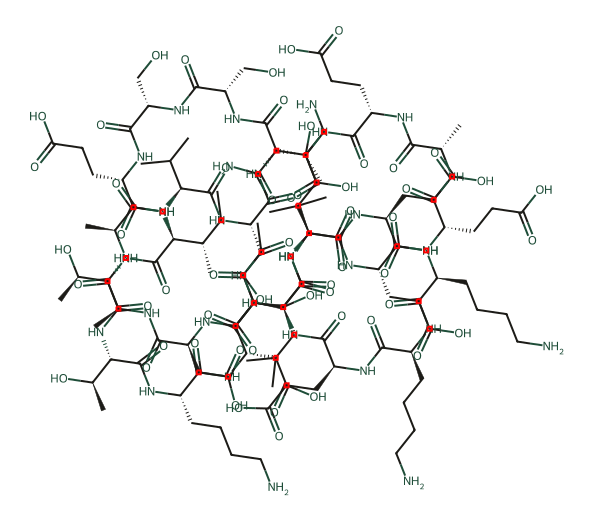
2D structure · PubChem record, redrawn
Amino-acid sequence
- * N-terminus acetylated (Ac-Ser1)
- * C-terminus free acid (Asn28-OH)
Sequence per PubChem CID 16130571.
Dose ranges
Study-backed ranges carry a source you can open. Community ranges are widely reported but not clinically established - treat them as what people do, not as advice.
Chronic hepatitis B (studied regimens, as monotherapy or combined with interferon-alpha or nucleoside analogues)
study0.9 to 1.6 mg (some protocols dosed by body surface area at 0.9 mg/m2)
subcutaneous injection two to three times weekly for 6 to 12 months
Chronic hepatitis C (studied regimen, combined with interferon-alpha)
study1.6 to 2 mg
subcutaneous injection twice weekly alongside interferon, for 6 to 12 months
Severe sepsis (hospital randomized-trial regimen)
study1.6 mg
subcutaneous injection twice daily (about every 12 hours) for 5 to 7 days in hospitalized patients
Cancer adjuvant therapy (various solid tumors, studied regimens combined with chemotherapy and/or interferon)
study0.9 to 6.4 mg (commonly dosed as 0.9 mg/m2 in older protocols)
subcutaneous injection from daily to twice weekly, for weeks to months depending on the protocol
Vaccine adjuvant in older or immunocompromised adults (studied regimen, influenza or hepatitis B vaccination)
study0.9 to 1.6 mg (or 0.9 mg/m2)
subcutaneous injection twice weekly for 2 to 5 weeks around the time of vaccination
COVID-19 (regimen described in published reports; not an FDA-reviewed indication)
studyup to 10 mg
subcutaneous injection once daily for at least 7 consecutive days in hospitalized patients, per a peer-reviewed literature review
Community-reported general use (self-directed, outside clinical trials or medical supervision)
communitycommonly 1 to 1.6, occasionally higher mg
subcutaneous injection 2 to 3 times per week, duration self-selected
Reconstitution & storage
The clinical single-dose Zadaxin vial (1.6 mg) is labeled for reconstitution with 1 mL of sterile water for injection immediately before use, yielding a concentration of 1.6 mg/mL, and the labeling states the reconstituted product should be used immediately with no stated shelf life once mixed. Research-sold multi-dose vials (commonly 5 mg or 10 mg) are reconstituted by vendors and community sources with roughly 1 to 3 mL of bacteriostatic water; those volumes and any claimed post-reconstitution refrigerated storage window are community-reported and not clinically validated for this product.
Lyophilized
The manufacturer's ex-US product labeling states that unopened lyophilized vials should be stored refrigerated at 2 to 8 C (36 to 46 F).
Reconstituted
The same labeling states the reconstituted product should be used immediately, with no shelf life given for storing it after mixing; it also states Zadaxin should not be mixed with any other drug in the same syringe.
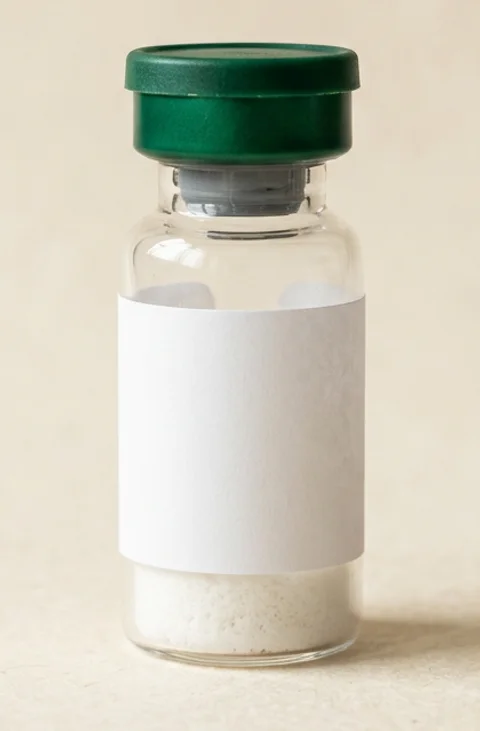
Ships as a white lyophilized powder cake in a 3 mL glass vial (1.6, 5, 10 mg sizes are typical), reconstituted with bacteriostatic water before use.
Run the numbers in the calculatorInteractions & cautions
No formal drug-drug interaction studies for thymosin alpha-1 have been published. It has been studied and used clinically in combination with interferon-alpha for hepatitis B, hepatitis C, HIV, and some cancer protocols without evidence of added toxicity in those trials, so combination with interferon is a standard studied approach rather than a flagged interaction. The clinically important caution is pharmacodynamic rather than a drug interaction in the strict sense: because thymosin alpha-1 is an immune-stimulating peptide, ex-US prescribing information and an independent peer-reviewed review both state it is contraindicated in patients who are being deliberately immunosuppressed, such as organ transplant recipients, unless the potential benefit is judged to clearly outweigh the risk.
Questions people ask
Is thymosin alpha-1 FDA-approved?
No. Thymosin alpha-1 (Zadaxin) has no FDA drug label and does not appear in the DailyMed database. The manufacturer's own product monograph states plainly that Zadaxin has not been approved for sale in the United States or Europe. It is approved as a prescription medicine in more than 30 other countries, mainly for chronic hepatitis B and C.
What is the reported half-life?
A pharmacokinetic study in healthy volunteers given a single subcutaneous dose reported an elimination half-life of under 3 hours across different formulations, with peak serum levels at 1 to 2 hours. A separate pharmacy literature review cites approximately 2 hours, which is consistent with that study.
Does thymosin alpha-1 work for sepsis?
The evidence is mixed and trends negative in the most rigorous trial available. A smaller 2013 randomized trial (n=361) reported lower 28-day mortality with thymosin alpha-1 than control, though its relative-risk confidence interval bordered on 1. A much larger, more rigorous 2025 randomized, placebo-controlled phase 3 trial (n=1,089) found essentially no difference in 28-day mortality between thymosin alpha-1 and placebo.
How is it typically administered and reconstituted?
In clinical studies and its ex-US labeling, thymosin alpha-1 is given by subcutaneous injection. The clinical single-dose vial (1.6 mg) is reconstituted immediately before use with 1 mL of sterile water for injection to a concentration of 1.6 mg/mL, and the labeling states the reconstituted product should be used right away rather than stored. Community and vendor sources describe different reconstitution practices for larger multi-dose research vials, but these are not clinically validated.
Are there known interactions or contraindications?
No formal drug interaction studies have been published. Ex-US labeling and a peer-reviewed review both state that thymosin alpha-1 is contraindicated in patients who are being deliberately immunosuppressed, such as organ transplant recipients, since as an immune-stimulating agent it could work against intended immunosuppression, unless the potential benefit is judged to outweigh that risk.
Sources
- [1]DailyMed search results for "thymalfasin"regulatoryConfirms DailyMed returns zero drug label results for thymalfasin (or thymosin alpha), consistent with the product having no FDA-approved US label.
- [2]Zadaxin Product Monograph (SciClone Pharmaceuticals)regulatoryManufacturer monograph states verbatim that 'ZADAXIN has not been approved for sale in the United States or Europe,' that it 'is approved in over 30 countries,' gives its chemical structure (28 amino acids, molecular weight 3108), and summarizes dosing (0.6 to 9.6 mg/m2 or 1 mg to 16 mg, mostly subcutaneous biweekly) and safety data (more than 3,000 patients in over 70 studies, no serious adverse experiences reported).
- [3]Zadaxin (Thymalfasin): Side Effects, Uses, Dosage, Interactions, Warnings (RxList)referenceGives reconstitution instructions (1.0 mL sterile water for injection to 1.6 mg/mL), storage (2-8 C, use immediately after reconstitution), the 1.6 mg twice-weekly hepatitis dosing regimen, and the contraindication in deliberately immunosuppressed patients such as organ transplant recipients.
- [4]Thymalfasin, PubChem Compound Summary (CID 16130571)referenceConfirms chemical identity: compound name Thymalfasin, molecular formula C129H215N33O55, PubChem CID 16130571.
- [5]Thymosin alpha 1: A comprehensive review of the literature (Dominari et al, World J Virol 2020) PMID 33362999reviewPeer-reviewed review stating thymalfasin is approved in more than 35 countries for hepatitis B and C and holds FDA orphan drug designation for melanoma, chronic active hepatitis B, DiGeorge anomaly, and hepatocellular carcinoma; gives dosing regimens for hepatitis B (1.6 mg SC twice weekly), sepsis (1.6 mg SC twice daily for 5 days), cancer (0.8-16 mg), and COVID-19 (10 mg SC once daily for at least 7 days); and states it is contraindicated in immunosuppressed patients such as organ transplant recipients.
- [6]Immune Modulation with Thymosin Alpha 1 Treatment (King & Tuthill, Vitamins and Hormones 2016) PMID 27450734reviewPeer-reviewed review describing thymosin alpha-1's mechanism as pleiotropic immune modulation acting through Toll-like receptors on dendritic and myeloid cells, supporting the general mechanism-of-action framing.
- [7]The efficacy of thymosin alpha 1 for severe sepsis (ETASS): a multicenter, single-blind, randomized and controlled trial (Wu et al, Critical Care 2013) PMID 23327199studyRandomized trial (n=361; 180 control, 181 thymosin alpha-1) reporting 28-day mortality of 26.0% versus 35.0% (relative risk 0.74, 95% CI 0.54 to 1.02), the basis for the sepsis dose range and the ETASS versus TESTS comparison discussed in the FAQ.
- [8]The efficacy and safety of thymosin alpha1 for sepsis (TESTS): multicentre, double blinded, randomised, placebo controlled, phase 3 trial (Wu et al, BMJ 2025) PMID 39814420studyLarge phase 3 randomized placebo-controlled trial (n=1,089; 542 thymosin alpha-1, 547 placebo) given subcutaneously every 12 hours for 7 days, finding 28-day mortality of 23.4% versus 24.1% (hazard ratio 0.99, 95% CI 0.77-1.27, P=0.93), concluding no clear mortality benefit in sepsis.
- [9]Combination therapy with thymosin alpha1 and interferon for the treatment of chronic hepatitis C infection: a randomized, placebo-controlled double-blind trial (Sherman et al, Hepatology 1998) PMID 9537454studyUS randomized double-blind trial (n=109) of thymosin alpha-1 1.6 mg SC twice weekly plus interferon versus interferon alone versus placebo, reporting end-of-treatment biochemical response of 37.1% versus 16.2% (P=0.04), supporting the hepatitis C dose range and overview claim of modest combination benefit.
- [10]Thymosin-alpha 1 plus interferon-alpha for naive patients with chronic hepatitis C: results of a randomized controlled pilot trial (Andreone et al, J Viral Hepat 2004) PMID 14738560studyRandomized pilot trial (n=41) showing combination therapy achieved significantly higher end-of-treatment virological response than interferon monotherapy (P=0.03), though sustained response rates were comparable at follow-up, supporting the honest caveat that hepatitis C benefit is often not durable.
- [11]Thymosin Alpha 1 Reduces the Mortality of Severe Coronavirus Disease 2019 by Restoration of Lymphocytopenia and Reversion of Exhausted T Cells (Liu et al, Clinical Infectious Diseases 2020) PMID 32442287studyRetrospective study of 76 severe COVID-19 cases reporting thymosin alpha-1 treatment significantly reduced mortality (11.11% vs 30.00%, P=.044) and restored CD4/CD8 T-cell counts, the basis for the COVID-19 mention in the overview (with the caveat that this is retrospective, not randomized, evidence).
- [12]Thymosin alpha 1 as an adjunct to influenza vaccination in the elderly: rationale and trial summaries (Ershler et al, Ann NY Acad Sci 2007) PMID 17600281reviewPeer-reviewed review of trials showing thymosin alpha-1 enhanced antibody responses to influenza vaccination in elderly subjects, supporting the vaccine-adjuvant dose range and context.
- [13]Large randomized study of thymosin alpha 1, interferon alfa, or both in combination with dacarbazine in patients with metastatic melanoma (Maio et al, J Clin Oncol 2010) PMID 20194853studyRandomized phase 2 trial (n=488) testing thymosin alpha-1 at 1.6, 3.2, and 6.4 mg SC with dacarbazine plus interferon, reporting median overall survival of 9.4 versus 6.6 months (hazard ratio 0.80, 95% CI 0.63-1.02, P=.08), a non-statistically-significant trend used to support the cancer dose range while noting the result did not reach significance.
- [14]Thymalfasin, a promising adjuvant therapy in small hepatocellular carcinoma after liver resection (He et al, Medicine (Baltimore) 2017) PMID 28422855studyRetrospective cohort (n=206) using thymalfasin 1.6 mg SC twice weekly for at least 26 weeks after liver resection, reporting improved 1/3/5-year overall survival (97.7%/90.6%/82.9% vs 95.1%/80.5%/62.9%, P=.014) versus resection alone, supporting the cancer-adjuvant dosing and overview claim of retrospective benefit in hepatocellular carcinoma.
- [15]Thymosin alpha 1 alleviates inflammation and prevents infection in patients with severe acute pancreatitis through immune regulation: a systematic review and meta-analysis (Tian et al., 2025) PMID 40599771reviewMeta-analysis of 5 randomized controlled trials (706 patients with severe acute pancreatitis) finding thymosin alpha-1 reduced extrapancreatic infection rates (RR=0.56, P=0.0005) and improved CD4+ and CD4+/CD8+ immune parameters, used to support the general statement that evidence outside hepatitis and sepsis is limited to small/pooled trials in adjacent critical-care conditions.
- [16]Efficacy of thymosin alpha-1 plus peginterferon alpha-2a combination therapy compared with peginterferon alpha-2a monotherapy in HBeAg-positive chronic hepatitis B: a prospective, multicenter, randomized, open-label study (Scandinavian Journal of Gastroenterology 2012) PMID 22726105studyRandomized trial (26 combination vs 25 peginterferon-alone patients) finding no statistically significant difference in combined response rate at end of treatment (15.4% vs 12.0%, P=0.725), used as an honest counterexample showing not all hepatitis B trials favor thymosin alpha-1.
- [17]Combination of entecavir with thymosin alpha-1 in HBV-related compensated cirrhosis: a prospective multicenter randomized open-label study (Expert Opinion on Biological Therapy 2018) PMID 30063860studyRandomized trial (351 combination vs 339 entecavir-monotherapy patients with HBV-related compensated cirrhosis) finding no significant difference in the composite endpoint of liver decompensation, hepatocellular carcinoma, or death, another honest counterexample of a large, largely negative hepatitis B trial.
- [18]Thymosin alpha-1 (Ancell, Phipps & Young, American Journal of Health-System Pharmacy 2001) PMID 11381492reviewPharmacy literature review reporting a half-life of approximately 2 hours, time to peak concentration within 2 hours, return to baseline by 24 hours, and a standard dose of 1.6 mg SC twice weekly, the basis for the half-life value.
- [19]Pharmacokinetics of thymosin alpha1 after subcutaneous injection of three different formulations in healthy volunteers (Rost et al, International Journal of Clinical Pharmacology and Therapeutics 1999) PMID 10027483studyDedicated pharmacokinetic study in healthy volunteers at a 900 microg/m2 (about 1.6 mg) subcutaneous dose, reporting elimination half-life under 3 hours, time to maximum concentration of 1-2 hours, and no evidence of drug accumulation, the primary source for the half-life value.
What we could not verify
The exact per-injection dose used in the retrospective COVID-19 mortality study (Liu et al 2020) could not be confirmed; its abstract reports the mortality result but not the dose, so the COVID-19 dose_ranges entry above is sourced to a separate literature review rather than to that specific study. A claim circulating on vendor and peptide-blog sites, that thymosin alpha-1 was 'reclassified' in February 2026, traces to a real event but is routinely garbled: on February 27, 2026 the HHS Secretary announced an intent to move roughly 14 of 19 peptides, thymosin alpha-1 among them, from the FDA's restricted Category 2 compounding list back to Category 1. That is an announcement of intent, not FDA approval, and Category 1 only governs whether a pharmacy may compound a substance while review continues; it does not establish approval, proven safety, or a standard dose. Thymosin alpha-1 was also not among the seven peptides the FDA advisory committee actually voted on in July 2026, so its compounding status remained unsettled as of this record. The specific vendor phrasing '503A Category 2 status' conflates the categories and should be treated with caution; see our peptide regulation tracker for the dated, sourced sequence. The CAS registry number was not confirmed against a resolving source and is omitted rather than guessed. Formal controlled data on use in pregnancy or in pediatric patients were not found; the manufacturer's own product monograph claims safe use in patients as young as 13 months and as old as 101 years, but that is manufacturer-reported observational experience, not controlled pediatric or pregnancy trial data, so pregnancy and pediatric safety should be treated as unestablished. Most positive hepatitis B, hepatitis C, and cancer trials cited here are small (tens to low hundreds of patients), several are open-label rather than blinded, and a number were summarized by the manufacturer (SciClone) in its own product monograph, which is promotional literature rather than independent peer review, though the specific trial results it cites were cross-checked against independently retrieved PubMed abstracts where possible (for example the Sherman 1998 hepatitis C trial) and were broadly consistent. Two large, more rigorous, and more recent randomized trials (the 2025 TESTS sepsis trial and a 2012 HBeAg-positive hepatitis B trial) found no significant benefit, directly contradicting smaller, older positive trials for the same indications; this record deliberately reports both the positive and negative trials rather than only the favorable ones. Whether the FDA orphan drug designations mentioned in the Dominari 2020 review (for melanoma, chronic active hepatitis B, DiGeorge anomaly, and hepatocellular carcinoma) remain current, or ever converted into any US marketing approval, could not be independently confirmed; the absence of any DailyMed listing indicates no approval has resulted.
Keep reading
Pepteca is for education and information only. It does not provide medical advice, diagnosis, or treatment, and its calculators perform unit math only. Always verify with a licensed provider before starting, changing, or stopping any protocol. Many peptides are not approved for human use and may be regulated differently where you live.