cat. no. SS-31
SS-31: dosage, half-life and storage
Mitochondria-targeting synthetic tetrapeptide (D-Arg-2,6-dimethyl-Tyr-Lys-Phe-NH2) that binds cardiolipin on the inner mitochondrial membrane; approved as the prescription drug FORZINITY (elamipretide) only for Barth syndrome, and sold separately as unapproved research-grade SS-31.
also: Elamipretide / Forzinity / MTP-131 / Bendavia / SS-31
By An NayalLast reviewed 11 sources
At a glance
On this card (7)
What it is
SS-31 is the research name for elamipretide, a synthetic four-amino-acid peptide (D-Arg-2,6-dimethyl-Tyr-Lys-Phe-NH2) that concentrates in mitochondria and binds cardiolipin, a lipid of the inner mitochondrial membrane, which is thought to stabilize cristae structure and support oxidative phosphorylation. The single most important fact: on September 19, 2025 the FDA granted ACCELERATED approval to elamipretide under the brand name FORZINITY (Stealth BioTherapeutics) to improve muscle strength in adult and pediatric patients with Barth syndrome weighing at least 30 kg. It is the first FDA-approved mitochondria-targeted therapeutic. That approval is narrow, hard-won, and honest about a mixed record. Elamipretide FAILED multiple prior trials: the MMPOWER-3 phase 3 trial in primary mitochondrial myopathy missed its primary endpoints, the ReCLAIM-2 phase 2 trial in geographic atrophy (dry AMD) missed its primary endpoints, and even the Barth syndrome TAZPOWER trial missed both primary endpoints in its randomized crossover phase before an open-label extension and a knee-extensor strength signal built the eventual accelerated-approval case. FORZINITY is NOT approved for longevity, anti-aging, or general performance, and there is essentially no rigorous human evidence for those uses. The 'SS-31' sold by research-peptide vendors is the same molecule but is unapproved gray-market material, not FORZINITY, and is not a substitute for the approved drug.
The molecule
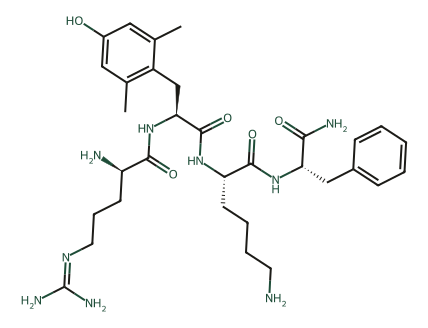
2D structure · PubChem record, redrawn
Amino-acid sequence
- * Position 1: D-Arg
- * Position 2: Dmt (2',6'-dimethyl-L-tyrosine)
- * C-terminus amidated (Phe4-NH2)
Sequence per PubChem CID 11764719 - X marks a non-standard residue, detailed above.
Dose ranges
Study-backed ranges carry a source you can open. Community ranges are widely reported but not clinically established - treat them as what people do, not as advice.
FDA-approved FORZINITY dosing for Barth syndrome (patients weighing at least 30 kg)
study40 mg (supplied 80 mg/mL solution, no reconstitution)
subcutaneous injection once daily, at the same time each day
Primary mitochondrial myopathy (MMPOWER-3 phase 3 trial regimen; the trial failed its primary endpoints)
study40 mg
subcutaneous injection once daily for 24 weeks
Geographic atrophy / dry age-related macular degeneration (ReCLAIM-2 phase 2 trial regimen; the trial missed its primary endpoints)
study40 mg
subcutaneous injection once daily for 48 weeks
Community-reported research-grade SS-31 protocols (unregulated, no clinical trial support, and notably lower than the approved 40 mg/day dose)
community5 to 20 mg
subcutaneous injection, commonly once daily and self-cycled; no published human trial has used these low doses
Reconstitution & storage
Two different products must not be blurred. The FDA-approved drug FORZINITY is NOT a powder you reconstitute: it is supplied as a ready-to-use single-patient-use vial of 280 mg/3.5 mL (80 mg/mL) sterile aqueous solution for subcutaneous injection. Separately, research-peptide vendors sell gray-market 'SS-31' as a lyophilized powder in vials commonly listed around 10 mg or 50 mg, which community and vendor sources reconstitute with roughly 1 to 3 mL of bacteriostatic water. Those vial sizes and reconstitution volumes are unregulated community practice for unapproved material, not a manufacturer or clinical protocol, and gray-market powder is not FORZINITY.
Lyophilized
Research-grade SS-31 powder is reported by community and vendor sources to be stored frozen or refrigerated, protected from light, until reconstitution; there is no manufacturer or clinical stability standard for that unapproved material.
Reconstituted
The approved drug FORZINITY is stored refrigerated at 2 to 8 C (36 to 46 F) and must not be frozen; after first opening, a vial may be kept refrigerated or at room temperature (20 to 25 C) and must be discarded 8 days after first opening. Community sources report refrigerating reconstituted gray-market SS-31 solution at 2 to 8 C and avoiding freezing, but that is unregulated practice, not a validated stability finding.
Ships as a white lyophilized powder cake in a 3 mL glass vial (10, 50 mg sizes are typical), reconstituted with bacteriostatic water before use.
Run the numbers in the calculatorInteractions & cautions
No formal drug-drug interaction studies are described for elamipretide, and the FORZINITY prescribing information does not list specific drug interactions as a highlighted concern; the dominant documented adverse effect is local injection-site reactions (erythema, induration, pruritus, pain, bruising, urticaria), which occurred in essentially all treated patients in the small Barth syndrome trial. Because elamipretide is a mitochondria-targeted peptide with low (about 39 percent) plasma protein binding and is distributed through total body water, classic protein-displacement or CYP-mediated interaction concerns are not prominent, but interaction data in humans are limited. Any interaction claims for gray-market research SS-31 are community-level and not supported by controlled human studies.
Questions people ask
Is SS-31 FDA-approved?
Partly, and the distinction matters. The molecule elamipretide was granted FDA accelerated approval on September 19, 2025 under the brand name FORZINITY (Stealth BioTherapeutics), but only to improve muscle strength in adult and pediatric patients with Barth syndrome who weigh at least 30 kg. It is the first FDA-approved mitochondria-targeted therapeutic and is supplied as a prescription 80 mg/mL subcutaneous solution. The accelerated approval means continued approval may depend on a confirmatory trial. The 'SS-31' sold by research-peptide vendors is the same molecule but is unapproved, gray-market material, not FORZINITY, and it is not FDA-approved for any use.
Is SS-31 approved for longevity or anti-aging?
No. FORZINITY is approved only for Barth syndrome, a rare genetic mitochondrial disease. It is not approved for longevity, anti-aging, general performance, or healthy people, and there is essentially no rigorous human evidence that elamipretide extends lifespan or reverses aging. Marketing that frames SS-31 as an anti-aging peptide is going well beyond what the approval or the human data support.
What is Barth syndrome, and how common is it?
Barth syndrome is an ultra-rare, X-linked genetic disorder caused by mutations in the TAFAZZIN gene, which disrupt remodeling of the mitochondrial lipid cardiolipin and impair mitochondrial function, causing muscle weakness, cardiomyopathy, and other problems primarily in males. It is extremely rare, reported to affect on the order of 150 individuals in the United States, and before FORZINITY there was no approved therapy for it.
Has SS-31 failed clinical trials?
Yes, several. The phase 3 MMPOWER-3 trial in primary mitochondrial myopathy (n=218, 40 mg/day subcutaneous) did not meet its primary endpoints, though a nuclear-DNA subgroup showed a walk-test signal. The phase 2 ReCLAIM-2 trial in geographic atrophy (dry AMD) missed its primary endpoints, salvaging only secondary ellipsoid-zone signals. Even in Barth syndrome, the randomized crossover phase of the TAZPOWER trial missed both primary endpoints; the approval case was built on the later open-label extension and a knee-extensor strength measure. This mixed, honest record is part of why the eventual approval was narrow and accelerated rather than broad.
What is SS-31's half-life?
The FDA FORZINITY label reports that peak concentrations are reached about 0.5 to 1 hour after subcutaneous injection with roughly 92 percent bioavailability, but it does not publish a specific elimination half-life. Secondary sources describe a short plasma half-life on the order of a few hours (roughly 1 to 4 hours). A notable point is that elamipretide binds cardiolipin inside mitochondria, so its biological effect may outlast its measurable time in blood; that pharmacodynamic idea is mechanistic, not a validated clinical dosing rule.
How is FORZINITY given, and is it the same as reconstituted research SS-31 powder?
FORZINITY is supplied as a ready-to-use 280 mg/3.5 mL (80 mg/mL) single-patient-use vial and is injected subcutaneously at 40 mg once daily; it is not a powder you reconstitute. Research-peptide vendors separately sell gray-market 'SS-31' as a lyophilized powder that community sources reconstitute with bacteriostatic water. Those are not the same product: the vendor powder is unapproved, its purity and dose are not FDA-verified, and community reconstitution and dosing figures are unregulated practice, not a clinical standard.
Sources
- [1]Stealth BioTherapeutics Announces FDA Accelerated Approval of FORZINITY (elamipretide HCl), the First Therapy for Barth Syndrome (PR Newswire, 2025)press releaseStates the FDA granted accelerated approval on September 19, 2025 to FORZINITY (elamipretide HCl) to improve muscle strength in adult and pediatric patients with Barth syndrome weighing at least 30 kg; that it is the first FDA-approved mitochondria-targeted therapeutic; that Barth syndrome affects roughly 150 individuals in the United States and about 1 in 1,000,000 male births; and that continued approval is contingent on a confirmatory trial.
- [2]FORZINITY (elamipretide hydrochloride injection) Prescribing Information (DailyMed, Stealth BioTherapeutics)regulatoryOfficial FDA label: indicated to improve muscle strength in adult and pediatric patients with Barth syndrome weighing at least 30 kg; recommended dosage 40 mg subcutaneously once daily; supplied as 280 mg/3.5 mL (80 mg/mL) single-patient-use vials; store refrigerated 2 to 8 C, do not freeze, discard 8 days after first opening; Tmax 0.5 to 1 hour, absolute subcutaneous bioavailability about 92 percent, volume of distribution about 0.5 L/kg, plasma protein binding about 39 percent; most common adverse reactions are injection-site reactions. Describes elamipretide as a mitochondrial cardiolipin binder.
- [3]FORZINITY (elamipretide) for Muscle Strength in Barth Syndrome, USA (Clinical Trials Arena project profile)referenceIndependent secondary source confirming the September 2025 accelerated approval, the at-least-30-kg indication, first mitochondria-targeted therapy status, 40 mg once-daily subcutaneous dosing, the 280 mg/3.5 mL single-use vial formulation, and the regulatory history (2021 refusal-to-file letter for lacking a single adequate and well-controlled study, a May 2025 complete response letter, and a July 2025 resubmission under the accelerated pathway).
- [4]PubChem Compound Summary for CID 11764719, ElamipretidereferenceConfirms chemical identity: molecular formula C32H49N9O5, molecular weight about 639.8 g/mol, PubChem CID 11764719, and synonyms Elamipretide, SS-31, MTP-131, and Bendavia.
- [5]The mitochondria-targeted peptide SS-31 binds lipid bilayers and modulates surface electrostatics as a key component of its mechanism of action (Journal of Biological Chemistry, 2020) PMID 32273339studyMechanistic study showing SS-31/elamipretide partitions into the membrane interfacial region with affinity related to surface charge and modulates the surface electrostatics of model and mitochondrial membranes, supporting the cardiolipin-binding / inner-mitochondrial-membrane mechanism described on the page.
- [6]Efficacy and Safety of Elamipretide in Individuals With Primary Mitochondrial Myopathy: The MMPOWER-3 Randomized Clinical Trial (Neurology, 2023) PMID 37268435studyPhase 3 randomized placebo-controlled trial (n=218; 109 elamipretide, 109 placebo) of 40 mg/day subcutaneous elamipretide over 24 weeks that did not demonstrate a significant benefit on its primary endpoints (6-minute walk test and PMMSA total fatigue) in the overall population, with a nuclear-DNA subgroup showing a walk-test improvement; the basis for the failed-myopathy-trial claim.
- [7]A phase 2/3 randomized clinical trial followed by an open-label extension to evaluate the effectiveness of elamipretide in Barth syndrome (TAZPOWER, Genetics in Medicine, 2021) PMID 33077895studyTAZPOWER phase 2/3 trial in Barth syndrome in which, in the randomized crossover part 1, neither primary endpoint (6-minute walk test and Barth Syndrome Symptom Assessment) was met, with improvements seen later in the open-label extension; supports the honest statement that the pivotal Barth trial initially missed its primary endpoints.
- [8]Long-term efficacy and safety of elamipretide in patients with Barth syndrome: 168-week open-label extension results of TAZPOWER (Genetics in Medicine, 2024) PMID 38602181study168-week open-label extension reporting sustained improvements in functional assessments and cardiac function (for example cumulative 96.1 m 6-minute walk improvement by week 168, P=.003) that formed part of the accelerated-approval case, while injection-site reactions were the most common adverse events.
- [9]ReCLAIM-2: A Randomized Phase II Clinical Trial Evaluating Elamipretide in Age-related Macular Degeneration, Geographic Atrophy Growth, Visual Function, and Ellipsoid Zone Preservation (Ophthalmology Science, 2025) PMID 39605874studyPhase 2 randomized trial (n=176; 117 elamipretide, 59 placebo) of 40 mg/day subcutaneous elamipretide over 48 weeks in geographic atrophy that did not meet its primary endpoints (low-luminance visual acuity and geographic atrophy area), with secondary ellipsoid-zone preservation signals; the basis for the failed dry-AMD trial claim.
- [10]Randomized dose-escalation trial of elamipretide in adults with primary mitochondrial myopathy (MMPOWER, Neurology, 2018) PMID 29500292studyEarlier randomized dose-escalation trial of intravenous elamipretide (0.01, 0.1, and 0.25 mg/kg/h) in primary mitochondrial myopathy, documenting the compound's clinical development history and route/dose testing that preceded the later subcutaneous 40 mg/day trials.
- [11]SS-31 (Elamipretide) Dosage Chart (PeptideDeck, community/vendor guide)communityCommunity/vendor source documenting research-market SS-31 practice: lyophilized powder reconstituted with bacteriostatic water, community protocols clustering at roughly 5 to 20 mg/day (explicitly noting no published human trial used those low doses), and reconstituted-solution storage at 2 to 8 C, with an explicit disclaimer that these are unvalidated community experiments distinct from the approved product.
What we could not verify
No elimination half-life is published in the FDA FORZINITY label, which reports only Tmax (0.5 to 1 hour), absolute subcutaneous bioavailability (about 92 percent), volume of distribution (about 0.5 L/kg), and plasma protein binding (about 39 percent). The 'roughly 1 to 4 hours' plasma half-life shown on this page is therefore drawn from secondary/community descriptions rather than from the label or from a peer-reviewed pharmacokinetic abstract that could be opened and quoted directly, so it is labeled community and should be treated as approximate; the related claim that elamipretide's effect outlasts its plasma presence because it is retained in mitochondria is mechanistic, not a validated dosing parameter. Research-grade SS-31 vial sizes (commonly cited around 10 mg or 50 mg), bacteriostatic-water reconstitution volumes (1 to 3 mL), and low-dose community protocols (5 to 20 mg/day) come from vendor and enthusiast sources, not from a manufacturer or clinical standard, and describe unapproved gray-market material that is not FORZINITY; their purity, actual peptide content, and stability are not FDA-verified. Attempts to open the FDA accessdata.fda.gov label PDF (NDA 215244) and the FiercePharma approval article returned HTTP 403, so the approval facts here are sourced to the DailyMed copy of the label, the Stealth BioTherapeutics press release, and the Clinical Trials Arena project profile instead; those three independently agree on the September 19, 2025 accelerated approval, the at-least-30-kg Barth syndrome indication, and the first-in-class mitochondrial status. The Barth syndrome US prevalence of about 150 individuals comes from the manufacturer's press release rather than an independent registry. No CAS registry number was confirmed against a resolving source and is omitted rather than guessed. Rigorous human evidence for any longevity, anti-aging, cognitive, or general-performance benefit of SS-31/elamipretide was not found; such uses are unproven and are not part of the FDA approval.
Keep reading
Pepteca is for education and information only. It does not provide medical advice, diagnosis, or treatment, and its calculators perform unit math only. Always verify with a licensed provider before starting, changing, or stopping any protocol. Many peptides are not approved for human use and may be regulated differently where you live.