cat. no. NAD-PLUS
NAD+: dosage, half-life and storage
Essential cellular coenzyme (redox cofactor; substrate for sirtuins and PARPs), sold as a compounded IV or subcutaneous injection
also: Nicotinamide adenine dinucleotide / NAD / beta-NAD
By An NayalLast reviewed 12 sources
At a glance
On this card (8)
What it is
NAD+ (nicotinamide adenine dinucleotide) is a coenzyme every cell uses to turn food into energy and to run repair and longevity pathways, including the sirtuin enzymes. Levels fall with age, which is the whole pitch behind NAD+ IV drips and subcutaneous shots marketed for energy, anti-aging, and addiction recovery. Here is the honest state of the evidence, kept separate from the hype: there is no randomized controlled trial showing that injected NAD+ improves energy, slows aging, or treats addiction in humans, and a 2026 systematic review of 113 studies found no outcomes trials of intravenous or intramuscular NAD+ at all for these uses. What exists is a single 8-person pharmacokinetic study, a small tolerability review, an unpublished preprint, and one uncontrolled 50-case addiction series - pilots and anecdotes, not proof. Oral and 'liposomal' NAD+ face a bigger problem: the intact molecule is not meaningfully absorbed through the gut, which is exactly why the supplement industry sells precursors (NR and NMN) instead. Those precursors do have a real, if still early, human trial base showing they raise blood NAD+ - but that evidence is about NR and NMN, not about NAD+ injections, and does not transfer. And because injectable NAD+ is an unregulated compounded product, safety is not guaranteed: a contaminated batch was recalled after patients were harmed. This page lays out what has and has not actually been measured.
The molecule
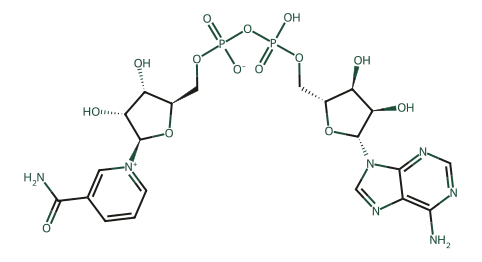
2D structure · PubChem record, redrawn
Dose ranges
Study-backed ranges carry a source you can open. Community ranges are widely reported but not clinically established - treat them as what people do, not as advice.
IV - the only dedicated human pharmacokinetic study (n=8)
study750 mg per 6-hour infusion (~2 mg/min)
single infusion
IV - real-world tolerability pilot (retrospective, n=6)
study500 mg per infusion
once daily for 4 consecutive days
IV / IM / SubQ - safety preprint dosing NAD+ itself (4-6 per arm, not peer-reviewed)
study100 mg per injection
once daily for 3 days
IV - clinic / wellness protocol
community300-1000 mg per session
over 1-6 hours, loading then roughly weekly maintenance; community practice, not trial-derived
Subcutaneous - clinic titration protocol
community0.1-0.4 mL per injection (titrated up from a small starting volume)
2-3 times per week; community practice, dosed by volume rather than mg
Oral / liposomal
communitynot established -
intact NAD+ is not meaningfully absorbed by mouth, and no human dosing data supports oral NAD+ raising NAD+ levels
Reconstitution & storage
NAD+ for injection is a compounded product, supplied either pre-mixed or as a powder to reconstitute with bacteriostatic water. Vial sizes and mixing ratios vary by pharmacy because there is no manufacturer standard - NAD+ injection is not FDA-approved. Clinic subcutaneous protocols often dose in mL of a made-up solution rather than in mg, so the reconstitution math matters.
Lyophilized
Powdered NAD+ is kept at controlled room temperature (20-25 C), protected from light and moisture. This is compounding-pharmacy and vendor guidance, not a tested manufacturer standard.
Reconstituted
After mixing with bacteriostatic water, refrigerate at 2-8 C, protect from light (amber vials are common), and discard if it darkens. Vendors disagree on shelf life - 14, 28, and 90 days are all cited - which is itself a sign this is compounding practice, not a validated standard.
Ships as a white lyophilized powder cake in a 3 mL glass vial (500, 1000 mg sizes are typical), reconstituted with bacteriostatic water before use.
Run the numbers in the calculatorTools for NAD+
Interactions & cautions
The documented risks of injectable NAD+ are less about drug interactions and more about the product itself and how it is given. Fast IV infusion commonly causes chest tightness, flushing, nausea, and cramping, which is why clinics slow the drip - the tolerability pilot reported substantial infusion-related symptoms. Because NAD+ injection is not FDA-approved and is made by compounding pharmacies, sterility and purity are not centrally guaranteed: the FDA issued a Class I recall (its most serious tier) for a compounded NAD+ injectable after a vial tested far above the safe endotoxin limit and three patients needed emergency care. There is no established list of drug interactions for injected NAD+ because the human data is too thin to have produced one - which is a reason for caution, not reassurance. Talk to a licensed provider, and treat any specific interaction claim you see online as unverified.
Questions people ask
Does NAD+ injection actually work for energy or anti-aging?
There is no randomized controlled trial showing that IV or subcutaneous NAD+ improves energy, slows aging, or treats addiction in people, and a 2026 systematic review of 113 studies confirmed no outcomes trials of injectable NAD+ exist for these uses. The human evidence for injected NAD+ is a handful of small pilot and tolerability studies plus one uncontrolled case series - enough to describe how it behaves in the body, not enough to prove any of the marketed benefits. The popular claims currently rest on cell and animal biology and personal reports, not controlled human trials.
Why do people inject NAD+ instead of taking a pill?
Because intact NAD+ is not meaningfully absorbed by mouth - it is broken down in the gut rather than crossing into the blood as NAD+. An independent advertising-review body found no human studies showing oral or 'liposomal' NAD+ actually raises NAD+ levels. That absorption problem is the reason the supplement world sells NAD+ precursors (NR, NMN) and the reason clinics use IV and subcutaneous routes.
Is NAD+ the same as NMN or NR?
No, and the difference matters. NR (nicotinamide riboside) and NMN (nicotinamide mononucleotide) are precursors your body converts into NAD+, and they have a real human trial base - for example, an NR trial raised whole-blood NAD+ by 22 to 142% depending on dose. NAD+ itself does not have that evidence for injections, and precursor trial results should not be used to justify NAD+ IV or subcutaneous therapy.
Is injectable NAD+ FDA-approved?
No. NAD+ injection is not FDA-approved and is available only as a compounded preparation through 503A pharmacies, which state that its safety and efficacy have not been evaluated by the FDA. That also means quality is not centrally guaranteed: the FDA issued a Class I recall for a compounded NAD+ injectable after a vial tested far above the safe endotoxin limit and three patients required emergency care.
What is a typical NAD+ dose?
There is no established effective dose because no dose-response trial exists. For reference only: the one human IV pharmacokinetic study used 750 mg over 6 hours, a tolerability pilot used 500 mg per day for 4 days, and clinic protocols commonly run 300-1000 mg per IV session or titrate subcutaneous shots by volume (about 0.1-0.4 mL). The clinic numbers are community practice, not trial-derived, and are listed here to inform, not to recommend.
Sources
- [1]Amjad S, et al. Role of NAD+ in regulating cellular and metabolic signaling pathways. Mol Metab. 2021 (PMC7973386) PMID 33609766reviewNAD+ as a core coenzyme in redox reactions and as the required cosubstrate for sirtuins and PARP1, which consume it.
- [2]Grant R, et al. Changes in the Human Plasma and Urine NAD+ Metabolome During a 6 Hour IV Infusion of NAD+. Front Aging Neurosci. 2019 (PMC6751327)studyThe only located human IV-NAD+ pharmacokinetic study (750 mg over 6 hours, n=8); delayed, non-standard kinetics with no half-life derived.
- [3]Gallagher C, Emmanuel OO. NAD+ supplementation for anti-aging and wellness: A PRISMA-guided systematic review of preclinical and clinical evidence. Ageing Res Rev. 2026 PMID 41655607reviewA 2026 systematic review of 113 studies: no outcomes trials evaluated intravenous or intramuscular NAD+ itself for anti-aging or wellness; oral NR and NMN show biochemical target engagement but heterogeneous, often null functional results.
- [4]Reyna et al. IV NAD+ versus NR: a retrospective tolerability pilot in a real-world setting. Front Aging. 2026 (PMC12907335)study500 mg IV real-world tolerability data and the explicit statement that no trials have compared clinical outcomes between NAD+ and its precursors.
- [5]NAD+ and Enkephalinase Inhibition Infusions in Substance Use Disorder in Fifty Cases. Curr Psychiatry Res Rev. 2022studyThe addiction-recovery NAD+ evidence base is a single uncontrolled 50-case pilot series whose own authors call for randomized controlled follow-up.
- [6]Nkrumah-Elie Y, et al. Preliminary Safety Analysis of Injections of Nicotinamide Riboside Chloride. medRxiv preprint. 2026studyOne of the only located human trials dosing NAD+ itself via SubQ/IM/IV (100 mg for 3 days, 4-6 subjects per arm); tolerability only, not peer-reviewed.
- [7]Song J, et al. The Safety and Antiaging Effects of NMN in Human Clinical Trials: an Update. Adv Nutr. 2023 (PMC10721522)reviewNAD+ itself cannot be absorbed orally or cross the cell membrane intact; catalogs the human NMN precursor trials that do exist - kept separate from NAD+ injection claims.
- [8]Conze D, Brenner C, Kruger CL. Safety and Metabolism of Long-term NIAGEN (Nicotinamide Riboside Chloride). Sci Rep. 2019 (PMC6611812)studyPrecursor context: an NR randomized trial (n=140) raised whole-blood NAD+ by 22, 51, and 142% at 100, 300, and 1000 mg. This is NR, not NAD+ injection.
- [9]Okabe K, et al. Oral NMN Is Safe and Efficiently Increases Blood NAD+ Levels in Healthy Subjects. Front Nutr. 2022 (PMC9036060)studyPrecursor context: an NMN trial raising blood NAD+, kept clearly separate from NAD+ injection claims.
- [10]Empower Pharmacy - NAD+ Injection (compounding pharmacy product page)communityStorage and reconstitution practice, and the explicit disclosure that NAD+ injection is not FDA-approved and is 503A-compounded only.
- [11]BBB National Programs, National Advertising Division decision re: Reus Research (Cata-Kor NAD+), 2025regulatoryAn independent advertising review finding no human clinical studies on oral or liposomal NAD+ ingestion raising NAD+ levels.
- [12]FDA Issues Class I Recall for NAD+ Injection Due to Elevated Endotoxin Levels (news, citing FDA enforcement report)regulatoryA real compounded-NAD+ safety incident: a Class I recall for endotoxin contamination after three patients required emergency care.
What we could not verify
No human half-life for injected NAD+ exists; circulating figures (for example a '2-hour' number attributed to a Cell Metabolism study) appear to trace to mouse and cell-culture precursor work, not human NAD+ injection data, so they are excluded. Reconstitution vial sizes, mixing ratios, and storage shelf life are compounding-pharmacy and vendor practice, not a manufacturer or clinical standard, and are labeled community. Clinic IV and subcutaneous dose ranges are community practice, not trial-derived. Precursor (NR, NMN) trial results are included only as clearly separated context and do not validate NAD+ injections. During research, a competitor page was found miscisting a precursor trial DOI as a subcutaneous-NAD+ trial; that error was not reproduced here.
Keep reading
Pepteca is for education and information only. It does not provide medical advice, diagnosis, or treatment, and its calculators perform unit math only. Always verify with a licensed provider before starting, changing, or stopping any protocol. Many peptides are not approved for human use and may be regulated differently where you live.