cat. no. MOTS-C
MOTS-c: dosage, half-life and storage
Investigational mitochondrial-derived peptide (16-amino-acid microprotein encoded within the mtDNA 12S rRNA region); AMPK-activating metabolic regulator; not an FDA-approved drug
also: MOTS-C / Mitochondrial ORF of the 12S rRNA type-c / Mitochondrial-derived peptide MOTS-c (MDP)
By An NayalLast reviewed 14 sources
At a glance
On this card (7)
What it is
MOTS-c (mitochondrial open reading frame of the 12S rRNA type-c) is a 16-amino-acid peptide that is unusual among signaling molecules because it is encoded directly in mitochondrial DNA, within the 12S rRNA gene, rather than in the nuclear genome. Discovered by Lee and colleagues in 2015, MOTS-c activates AMPK and influences glucose and lipid metabolism, and it is sometimes called an 'exercise mimetic' because human studies show that circulating and skeletal-muscle MOTS-c rise with acute exercise and that circulating levels decline with age. It is investigational and is not approved by the FDA or any regulator for any use; no drug label exists. Essentially all evidence that injected MOTS-c improves insulin sensitivity, obesity, or physical performance comes from mouse experiments using intraperitoneal doses of 5 to 15 mg/kg; no peer-reviewed human trial of native MOTS-c has yet reported results. A related synthetic analog, CB4211, completed Phase 1 human safety testing, and a separate Phase 2a trial of native MOTS-c in people with prediabetes is currently recruiting, but neither has published outcomes. Human-injectable dosing protocols circulating online come entirely from vendors and community reports, not clinical studies. Readers should treat MOTS-c as an early-stage research compound: its endogenous biology in humans is genuinely documented, but functional dosing evidence remains preclinical, animal-only. On the regulatory side, MOTS-c was removed from the FDA's restricted Category 2 compounding list in April 2026 and was one of six peptides an FDA advisory committee voted in July 2026 to recommend for the Section 503A Bulks List; that recommendation is nonbinding and does not make MOTS-c an approved drug or, by itself, legal to compound, and it adds no human efficacy evidence. See our peptide regulation tracker for the dated detail.
The molecule
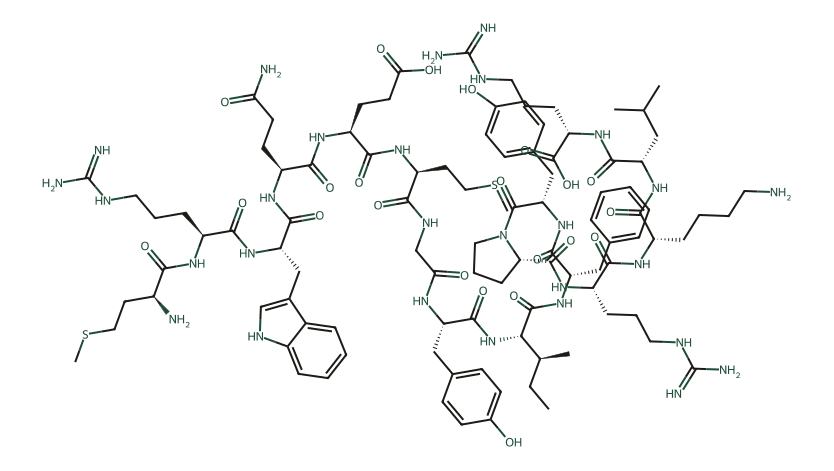
2D structure · PubChem record, redrawn
Dose ranges
Study-backed ranges carry a source you can open. Community ranges are widely reported but not clinically established - treat them as what people do, not as advice.
Mouse studies, acute intraperitoneal dosing (Reynolds et al. 2021)
study5-15 mg/kg
once daily, intraperitoneal injection, for periods up to about 2 weeks
Mouse studies, late-life intermittent dosing for physical capacity and healthspan
study5-15 mg/kg
3 times weekly, intraperitoneal injection, initiated around 24 months of age
Human Phase 1a/1b trial of CB4211, a synthetic MOTS-c analog (distinct molecule, not native MOTS-c)
studyNot publicly disclosed; multiple single- and multiple-ascending-dose cohorts mg
subcutaneous bolus injection, dose-escalation design, healthy adults and adults with NAFLD
Community-reported human injectable protocols (unregulated, no clinical trial support)
community2.5-10 mg
several times weekly, often cycled 8-12 weeks on with 4-8 weeks off
Reconstitution & storage
Community and vendor sources most commonly describe 5 mg or 10 mg lyophilized vials reconstituted with 1-3 mL bacteriostatic water (for example, 10 mg plus 2 mL yields roughly 5 mg/mL). No manufacturer or clinical reconstitution protocol exists because no MOTS-c drug product is FDA-approved or has a DailyMed label; these figures reflect unregulated community and compounding practice only, not a validated standard.
Lyophilized
Community sources report storing unreconstituted lyophilized MOTS-c powder frozen (around -20C), protected from light, until use. No manufacturer label or clinical stability study exists because MOTS-c is not an approved, marketed drug.
Reconstituted
Community sources report refrigerating reconstituted MOTS-c solution at 2-8C and using it within roughly 14-30 days, avoiding repeated freeze-thaw cycles and discarding if the solution becomes cloudy. This is unregulated community practice, not a validated clinical or manufacturer stability finding.
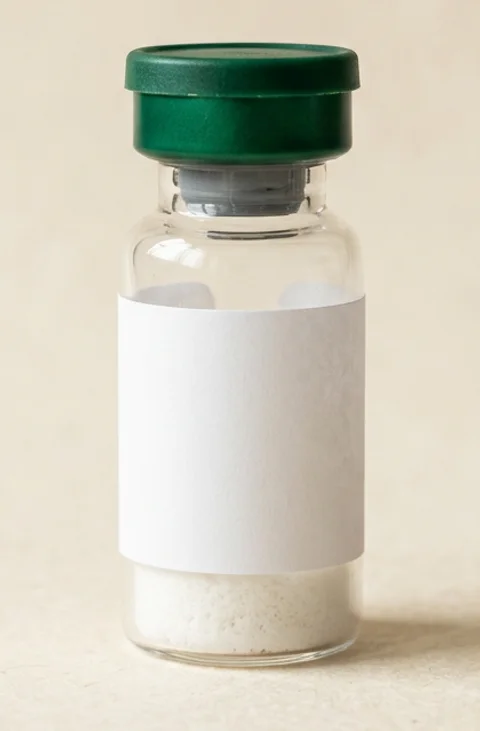
Ships as a white lyophilized powder cake in a 3 mL glass vial (5, 10 mg sizes are typical), reconstituted with bacteriostatic water before use.
Run the numbers in the calculatorInteractions & cautions
No peer-reviewed human drug-interaction studies exist for MOTS-c, since it has not completed a published human efficacy trial. Mechanistically, MOTS-c activates AMPK and increases insulin sensitivity in mouse studies (Lee et al. 2015), which is the biological basis for a theoretical, community-flagged concern that combining MOTS-c with insulin or insulin secretagogues (e.g., sulfonylureas) could compound glucose-lowering effects; this concern comes from community/vendor sources, not from a clinical interaction study, and has not been tested in humans. A related synthetic analog, CB4211, completed a Phase 1 safety/tolerability trial (NCT03998514) with no adverse-event results posted publicly as of this writing, and a Phase 2a trial of native MOTS-c (NCT07505745) is recruiting but has not reported safety data. Community and vendor sources additionally flag a theoretical caution about combining MOTS-c with metformin, since both activate AMPK, and suggest starting at a lower dose; like the insulin caution, this is community-level and not established in any human study.
Questions people ask
Is MOTS-c approved by the FDA?
No. A DailyMed search (the FDA's official drug label database) returns zero results for MOTS-c, and no MOTS-c product has an approved label. It exists only as a research and investigational compound.
Has MOTS-c been tested in humans?
Human data exist mainly for endogenous (naturally occurring) MOTS-c, such as studies showing plasma and muscle levels change with exercise and age. A Phase 2a trial of injected native MOTS-c in adults with prediabetes and overweight/obesity (NCT07505745) is recruiting as of this writing, and a related synthetic analog, CB4211, completed a Phase 1 human safety trial (NCT03998514), but neither has published efficacy results yet.
Where does the 5-15 mg/kg dosing figure come from?
That range comes from mouse studies using intraperitoneal injection, not from any human trial. It describes what researchers gave mice, not a human dose, and should not be read as one.
What is MOTS-c's half-life?
There is no published pharmacokinetic half-life for injected MOTS-c in humans. Community sources estimate roughly 1-4 hours, but this is extrapolated from how quickly exercise-induced endogenous MOTS-c returns to baseline in blood after exercise, not from a real clearance study of injected peptide.
How is MOTS-c typically reconstituted?
Community and vendor sources describe reconstituting lyophilized MOTS-c powder with bacteriostatic water, refrigerating the resulting solution, and using it within roughly 2-4 weeks. This reflects unregulated community and compounding practice, not a manufacturer or clinical protocol, since no approved MOTS-c drug product exists.
Why is MOTS-c called an 'exercise mimetic'?
Because human studies show acute exercise raises endogenous circulating MOTS-c (about 1.5 to 1.6-fold) and skeletal-muscle MOTS-c (reported as high as roughly 12-fold in one study), and mouse studies show MOTS-c treatment can improve physical performance and metabolic markers in ways that echo exercise adaptations. This reflects human correlational data plus animal causal data, not a proven human drug effect.
What did the FDA advisory committee decide about MOTS-c in 2026?
MOTS-c was removed from the FDA's restricted Category 2 compounding list in April 2026, and on July 23-24, 2026 it was one of six peptides an FDA advisory committee voted to recommend for the Section 503A Bulks List (the list of substances pharmacies may compound). That is a real signal, but it is a nonbinding recommendation, not FDA approval of a drug: the Health Secretary must accept it and the FDA must finish formal rulemaking before compounding is lawful, and none of it adds the human efficacy evidence MOTS-c still lacks.
Sources
- [1]The mitochondrial-derived peptide MOTS-c promotes metabolic homeostasis and reduces obesity and insulin resistance (Lee et al., Cell Metabolism 2015) PMID 25738459studyDiscovery and identity of the 16-amino-acid MOTS-c peptide encoded in mtDNA 12S rRNA; mouse data showing MOTS-c prevents age- and diet-induced insulin resistance and diet-induced obesity via AMPK activation.
- [2]A mitochondrially encoded hormone ameliorates obesity and insulin resistance (Zarse & Ristow, preview commentary, Cell Metabolism 2015) PMID 25738453reviewIndependent commentary summarizing the Lee et al. 2015 discovery and the AICAR/AMPK mechanism proposed for MOTS-c.
- [3]MOTS-c is an exercise-induced mitochondrial-encoded regulator of age-dependent physical decline and muscle homeostasis (Reynolds et al., Nature Communications 2021) PMID 33473109studyHuman exercise data (skeletal-muscle MOTS-c up 11.9-fold, circulating MOTS-c up 1.5-1.6-fold, returning to baseline by 4 hours); mouse dosing (5 or 15 mg/kg intraperitoneal) and late-life intermittent treatment improving physical capacity and showing a modest lifespan trend in mice.
- [4]Increased expression of the mitochondrial derived peptide, MOTS-c, in skeletal muscle of healthy aging men is associated with myofiber composition (Aging, Albany NY, 2020) PMID 32182209studyHuman data: circulating plasma MOTS-c declines with age while skeletal-muscle MOTS-c expression is about 1.5-fold higher in older and middle-aged men versus young men; correlates with myofiber composition and muscle quality.
- [5]A pro-diabetogenic mtDNA polymorphism in the mitochondrial-derived peptide, MOTS-c (Zempo et al., Aging, Albany NY, 2021) PMID 33468709studyLarge human cohort meta-analysis (n=27,527) linking the MOTS-c m.1382A>C (K14Q) variant to type 2 diabetes risk in sedentary men; companion mouse data showing native MOTS-c, but not the K14Q variant, improves glucose metabolism.
- [6]Systemic MOTS-c levels are increased in adults with obesity in association with metabolic dysregulation and remain unchanged after weight loss (Journal of Clinical & Translational Endocrinology, 2025) PMID 41551324studyHuman cohort data (22 lean vs 32 obese adults) showing circulating MOTS-c is higher in obesity (273 vs 223 pg/mL, p<0.01) and does not change after bariatric-surgery weight loss, suggesting a compensatory metabolic response rather than a simple deficiency state.
- [7]MOTS-c: A promising mitochondrial-derived peptide for therapeutic exploitation (Frontiers in Endocrinology review, 2023)reviewStates that, as of publication, no effective clinical method of applying MOTS-c had been developed and no completed human efficacy trials existed; summarizes mechanistic and preclinical translational status.
- [8]PubChem Compound Summary for CID 146675088, MOTS-creferenceConfirms MOTS-c chemical identity: 16-residue sequence Met-Arg-Trp-Gln-Glu-Met-Gly-Tyr-Ile-Phe-Tyr-Pro-Arg-Lys-Leu-Arg (MRWQEMGYIFYPRKLR), molecular formula C101H152N28O22S2, molecular weight approximately 2174.6 g/mol.
- [9]DailyMed search results for "MOTS-c"regulatoryConfirms zero FDA drug labels exist for MOTS-c, i.e., it is not an FDA-approved or labeled drug product.
- [10]ClinicalTrials.gov NCT03998514: A Phase 1a/1b Study of CB4211 in Healthy Non-obese Subjects and Subjects With Nonalcoholic Fatty Liver DiseaseregulatoryRegistry record for a completed Phase 1 subcutaneous dose-escalation trial of CB4211, a synthetic MOTS-c analog (not native MOTS-c), in 88 participants; no results posted on the registry as of this writing.
- [11]ClinicalTrials.gov NCT07505745: MOTS-c for Improving Insulin Sensitivity in Adults With Prediabetes and Overweight/ObesityregulatoryRegistry record for an ongoing/recruiting Phase 2a trial of native MOTS-c by subcutaneous injection over 12 weeks in adults with prediabetes and overweight/obesity, primary endpoint the Matsuda insulin-sensitivity index; no results posted yet.
- [12]MOTS-C Dosage Chart: Protocol Guide for Metabolic Health & Performance (Healthspan, community/vendor article)communityCommunity/vendor-reported dosing titration patterns, bacteriostatic-water reconstitution, and roughly 30-day refrigerated stability claims, with an explicit disclaimer that no universally accepted clinical dosing standard for MOTS-c exists; the page also carries community-level cautions about additive glucose-lowering with insulin and additive AMPK activation with metformin.
- [13]MOTS-c Dosage: Protocols & Timing (PeptidesExplorer, community/vendor article)communityCommunity/vendor-reported typical vial size (10 mg), reconstitution ratios, weekly dosing and cycling patterns, storage practices, and anecdotal side-effect and hypoglycemia-risk reports for injectable MOTS-c.
- [14]FDA advisory committee nominates six peptides for pharmacies to compound (NCPA, 2026)regulatoryReports that on July 23-24, 2026 the FDA Pharmacy Compounding Advisory Committee recommended six of seven reviewed peptides (including MOTS-c) for the 503A Bulks List, that the recommendation is nonbinding, that the HHS Secretary must formally approve, and that pharmacies may not compound them until final rulemaking is in place; the basis for the 2026 regulatory-status note and FAQ.
What we could not verify
No validated human pharmacokinetic half-life exists for injected/exogenous MOTS-c; the 1-4 hour figures circulating in community sources are extrapolated from how fast exercise-induced ENDOGENOUS circulating MOTS-c returns to baseline (Reynolds et al. 2021), not from a real clearance study of injected peptide. All specific numeric dosing shown to produce metabolic or performance effects (5-15 mg/kg, intraperitoneal, daily or 3x/week) comes exclusively from mouse studies; there is no published peer-reviewed human dosing study for native MOTS-c. A native-MOTS-c Phase 2a human trial (NCT07505745, sponsor Hudson Biotech) is recruiting as of this writing but has no posted results; a related but chemically distinct analog, CB4211 (CohBar), completed Phase 1 safety/PK testing (NCT03998514) with no results posted on the public registry, and secondary blog sources claim a 25 mg/day CB4211 dose that could not be confirmed against the primary registry record (which lists only unspecified ascending-dose cohorts) and is therefore NOT included as a sourced figure. Community-reported vial sizes, reconstitution ratios, injection frequencies, and cycling schedules are drawn from vendor and enthusiast blogs (gethealthspan.com, peptidesexplorer.com) and reflect commercial/community practice, not clinical guidance or a regulated pharmacy standard. Secondary search results describe MOTS-c and other AMPK activators as falling under the WADA Prohibited List (S4, hormone and metabolic modulators) for 2026, but repeated attempts to open a primary WADA document or page to confirm this directly were unsuccessful (page did not resolve via fetch), so this claim is NOT included as a sourced fact and should be independently verified before publication if athlete-relevant guidance is desired. No serious, clinically documented drug interaction or contraindication for MOTS-c was found in the peer-reviewed literature; the only interaction concern identified (theoretical hypoglycemia risk when combined with insulin or insulin secretagogues) comes from a community/vendor source, not a study, and is reported as such rather than elevated to a page-top interaction warning.
Keep reading
Pepteca is for education and information only. It does not provide medical advice, diagnosis, or treatment, and its calculators perform unit math only. Always verify with a licensed provider before starting, changing, or stopping any protocol. Many peptides are not approved for human use and may be regulated differently where you live.