cat. no. EPITHALON
Epithalon: dosage, half-life and storage
Synthetic tetrapeptide (Ala-Glu-Asp-Gly) modeled on the bovine pineal extract Epithalamin; investigated by a single Russian research group as a putative telomerase-activating longevity peptide. Not an approved drug in any jurisdiction.
also: Epitalon / Epithalone / AEDG / AEDG peptide
By An NayalLast reviewed 9 sources
At a glance
On this card (7)
What it is
Epithalon (also spelled Epitalon) is a synthetic four-amino-acid peptide (Ala-Glu-Asp-Gly, or AEDG) created by Vladimir Khavinson's laboratory at the St. Petersburg Institute of Bioregulation and Gerontology as a simplified version of Epithalamin, a natural bovine pineal gland extract. It is best known for claims that it activates telomerase and slows aging, but the evidence for this is thin and comes almost entirely from that one research group. The original 2003 finding that Epithalon activates telomerase and lengthens telomeres was done in cultured human fibroblasts in a dish, not in living people. In mice and fruit flies, the same group has reported modest lifespan extension. A 2025 study from Brunel University London independently replicated the telomerase and telomere-lengthening effect in normal human cell lines in vitro, which is a genuine positive sign, but that same study found a different, potentially concerning telomere-maintenance activation pathway in cancer cell lines. No published human clinical trial has tested the synthetic Epithalon peptide itself for safety, dosing, or anti-aging outcomes; separate elderly-mortality data sometimes cited for it actually studied Epithalamin, the related natural pineal extract, not the synthetic Epithalon peptide. Epithalon is not FDA- or EMA-approved and has no listing in DailyMed. In July 2026 an FDA advisory committee did vote to recommend adding Epitalon to the Section 503A Bulks List (the list of substances pharmacies may compound), evaluated for insomnia rather than longevity, but that recommendation is nonbinding and does not make it an approved drug or, by itself, legal to compound; see our peptide regulation tracker for the dated detail.
The molecule
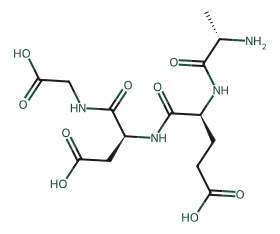
2D structure · PubChem record, redrawn
Dose ranges
Study-backed ranges carry a source you can open. Community ranges are widely reported but not clinically established - treat them as what people do, not as advice.
In vitro cell-culture concentration used in telomerase/telomere research (normal human fibroblast and epithelial cell lines)
study0.1 - 1.0 µg/mL added to culture medium
continuous exposure, days to weeks in culture (not a human dosing schedule)
Mouse lifespan/aging-biomarker studies (Khavinson/Anisimov group, CBA and SHR mouse strains)
study0.1 - 1 µg per mouse, subcutaneous
5 consecutive days per month (or per week in some protocols), started in mid-life and continued long-term
General 'anti-aging' self-administration protocol reported by peptide vendors and online communities
community5 - 10 mg/day, subcutaneous
once daily for approximately 10-20 consecutive days, repeated a few times per year
Reconstitution & storage
Community (vendor/forum) protocols commonly reconstitute 10 mg vials with 1-2 mL bacteriostatic water for roughly 5-10 mg/mL. No clinical or manufacturer-standard reconstitution protocol exists because Epithalon has no approved formulation; all reconstitution guidance found is community-sourced.
Lyophilized
Community-reported guidance (not from a stability study): keep frozen or refrigerated, protected from light, until reconstitution.
Reconstituted
Community-reported guidance (not from a stability study): refrigerate at approximately 2-8 C and avoid repeated freeze-thaw cycles; no published stability data define a validated in-use shelf life.
Ships as a white lyophilized powder cake in a 3 mL glass vial (5, 10, 20 mg sizes are typical), reconstituted with bacteriostatic water before use.
Run the numbers in the calculatorInteractions & cautions
No drug-drug or peptide-drug interaction studies of Epithalon exist in humans or animals; this section cannot be sourced beyond noting the absence of data. A separate biological caution is worth flagging: an independent 2025 in vitro replication (Al-Dulaimi et al., Biogerontology) that confirmed telomerase upregulation and telomere lengthening by Epitalon in normal human cell lines also found that in breast cancer cell lines (21NT, BT474), Epitalon increased telomere length primarily via activation of the alternative lengthening of telomeres (ALT) pathway rather than telomerase, with no significant net increase in telomerase enzyme activity in those cancer lines. Because unregulated telomere-maintenance activation (via either telomerase or ALT) is a recognized hallmark of cancer biology, this is a genuine, source-grounded reason for caution rather than a hypothetical one, even though no human carcinogenicity data exist either way.
Questions people ask
Does Epithalon actually activate telomerase in humans?
It has activated telomerase and lengthened telomeres in cultured human cells in vitro, in the original 2003 Khavinson study and in an independent 2025 replication from Brunel University London. Neither study involved live human subjects, so there is no direct evidence Epithalon activates telomerase inside a living person.
Is Epithalon the same thing as Epithalamin?
No. Epithalamin is a natural peptide extract from bovine pineal glands; Epithalon (AEDG) is a synthetic four-amino-acid peptide designed to reproduce part of its activity. Some human mortality and clinical data attributed to 'Epithalon' online actually studied Epithalamin, not the synthetic peptide, and the two should not be conflated.
Has Epithalon been tested in a human clinical trial?
No randomized, controlled human trial of the synthetic Epithalon peptide has been published. A small 2019 study exposed blood lymphocytes taken from 11 men (ages 18-22 and 49-54) to the AEDG peptide in the lab and found mixed telomere-length changes (both increases and decreases) in different subjects, which is not the same as an in-vivo treatment trial.
Does Epithalon extend lifespan?
In mice and fruit flies studied by Khavinson's group, Epithalon has been associated with modest lifespan extension (roughly 10-15% in several strains) and reduced tumor incidence in some experiments. No human lifespan or mortality trial of the synthetic peptide exists, so this claim is preliminary and animal-only.
Is Epithalon FDA-approved or regulated?
No. Epithalon has no FDA or EMA approval, no DailyMed listing, and no established medical dosing. It is sold only as a research chemical.
What did the FDA advisory committee decide about Epitalon in 2026?
On July 23-24, 2026, the FDA's Pharmacy Compounding Advisory Committee voted to recommend adding Epitalon to the Section 503A Bulks List, on a close reported tally of about 7-5 with one abstention, evaluated for insomnia. This matters, but three precisions are essential: it is a recommendation, not FDA approval of a drug; the vote is nonbinding, so the Health Secretary must accept it and the FDA must complete formal rulemaking before anything changes; and until that rulemaking finishes, Epitalon remains not lawfully compoundable and still has no human efficacy evidence behind the longevity claims made for it.
Sources
- [1]Epithalon peptide induces telomerase activity and telomere elongation in human somatic cells (Khavinson, Bondarev, Butyugov, 2003, Bull Exp Biol Med) PMID 12937682studyOriginal foundational finding: adding Epithalon to telomerase-negative human fetal fibroblast cultures induced telomerase catalytic subunit expression, enzymatic telomerase activity, and telomere elongation, in vitro.
- [2]Epitalon increases telomere length in human cell lines through telomerase upregulation or ALT activity (Al-Dulaimi, Thomas, Matta, Roberts, 2025, Biogerontology) PMID 40908429studyIndependent (Brunel University London) in vitro replication: confirms telomerase-mediated telomere lengthening in normal human cell lines (fibroblasts, epithelial cells), but finds ALT-pathway (not telomerase) activation with no net telomerase increase in breast cancer cell lines -- the basis for the cancer-related caution note.
- [3]Correction: Epitalon increases telomere length in human cell lines through telomerase upregulation or ALT activity (2025, Biogerontology) PMID 41240216studyPublished erratum confirming the correction to the Al-Dulaimi 2025 paper was limited to replacing incorrect versions of Figures 1-3; no textual conclusions were retracted.
- [4]Overview of Epitalon-Highly Bioactive Pineal Tetrapeptide with Promising Properties (Araj, Brzezik, Madra-Gackowska, Szeleszczuk, 2025, Int J Mol Sci) PMID 40141333reviewComprehensive 25-year literature review confirming: AEDG chemical identity; that essentially all in vivo evidence is animal-only (mouse, rat, Drosophila) at microgram subcutaneous doses; that no human clinical efficacy or safety trial of Epithalon has been published; and that physico-chemical/mechanistic data remain limited.
- [5]Effect of Peptide AEDG on Telomere Length and Mitotic Index of PHA-Stimulated Human Blood Lymphocytes (Khavinson et al., 2019, Bull Exp Biol Med) PMID 31761987studySmall ex vivo study (blood lymphocytes from 11 men, ages 18-22 and 49-54) treated with AEDG peptide in culture: found telomere-length changes (both increases and decreases) in 7 of 11 subjects' samples, described by the authors as 'a tendency to normalization' rather than a uniform increase -- used to correct the stronger 'clinical trial in patients aged 60-80' claim repeated on vendor sites, which this paper does not support.
- [6]Peptides of pineal gland and thymus prolong human life (Khavinson & Morozov, 2003, Neuroendocrinology Letters) PMID 14523363studyA follow-up of 193-266 elderly subjects given Thymalin and/or Epithalamin (the natural pineal/thymic extracts, NOT the synthetic Epithalon tetrapeptide) reported reduced mortality over 6-8 years; cited here only to document that this frequently-referenced 'human longevity data' concerns a different, related compound, not to support efficacy claims about synthetic Epithalon itself.
- [7]DailyMed search results for 'epithalon'regulatoryConfirms zero FDA drug product labels exist for Epithalon/Epitalon, i.e. it has no FDA-approved formulation.
- [8]PubChem Compound Summary for CID 219042, EpitalonreferenceConfirms chemical identity: molecular formula C14H22N4O9, consistent with the AEDG (Ala-Glu-Asp-Gly) tetrapeptide structure.
- [9]FDA advisory committee nominates six peptides for pharmacies to compound (NCPA, 2026)regulatoryReports that on July 23-24, 2026 the FDA Pharmacy Compounding Advisory Committee recommended six of seven reviewed peptides (including Epitalon) for the 503A Bulks List, that the recommendation is nonbinding, that the HHS Secretary must formally approve, and that pharmacies may not compound them until final rulemaking is in place; the basis for the 2026 regulatory-status note and FAQ.
What we could not verify
This is one of the thinnest-sourced compounds in the library and claims should be read accordingly. (1) Nearly all mechanistic and lifespan evidence -- the original telomerase finding, all mouse/rat/Drosophila lifespan studies, and the gene-expression work -- comes from one research group (Khavinson and collaborators, St. Petersburg Institute of Bioregulation and Gerontology); independent replication is limited to a single 2025 in vitro study (Al-Dulaimi et al., Brunel University London), which is a genuine positive but only covers cultured cells, not animals or humans. (2) No randomized, blinded, or placebo-controlled human clinical trial of the synthetic Epithalon (AEDG) peptide has been located. Vendor and blog content widely claims 'human clinical trials' showing telomere lengthening in patients aged 60-65 and 75-80, but the only human-tissue study we could locate and verify (Khavinson et al. 2019, PMID 31761987) is a small ex vivo lymphocyte experiment in men aged 18-22 and 49-54 with mixed (not uniformly positive) results -- the '60-80 years old patient trial' claim could not be verified against any primary source and should be treated as unverified marketing content, possibly a conflation with unrelated aging-biomarker cohorts. (3) The widely cited 'reduces elderly mortality' data (often stated as a fold-reduction in mortality, sometimes mislabeled online as a 'double-blind trial') is from Khavinson & Morozov 2003 in Neuroendocrinology Letters, which tested Thymalin and Epithalamin -- the natural thymic and pineal extracts -- not the synthetic Epithalon tetrapeptide, and used an open-label design without blinding or placebo control. This is a frequently made conflation on vendor sites and should not be presented as synthetic-Epithalon human evidence. (4) No pharmacokinetic study (half-life, bioavailability, clearance, volume of distribution) of Epithalon has been published in any species; all half-life figures circulating online are unsourced community estimates. (5) Reconstitution ratios, storage temperatures/shelf life, and 'protocol' dosing (mg/day, cycle length) are exclusively vendor- and forum-sourced community content with no clinical or stability-study backing -- there is no established human dose because there is no human trial. (6) Safety and side-effect data in humans are essentially absent from the peer-reviewed literature; the only source-grounded safety signal found is the theoretical cancer-biology caution described in interaction_warning, which itself has not been tested in vivo or in humans. Given all of the above, telomerase-activation and anti-aging/longevity claims for Epithalon should be treated as preliminary, single-group, and largely unreplicated outside the Khavinson laboratory, and any 'proven' framing of these claims should be flagged as overstated.
Keep reading
Pepteca is for education and information only. It does not provide medical advice, diagnosis, or treatment, and its calculators perform unit math only. Always verify with a licensed provider before starting, changing, or stopping any protocol. Many peptides are not approved for human use and may be regulated differently where you live.